Loading...
Searching...
No Matches
Unicode line editing
Create a field with ui::lineEdit to connect input, a model and history automatically. In this application F2 copies the current draft to the label and appends !; Enter confirms the field, Escape restores the model, and F10 exits.
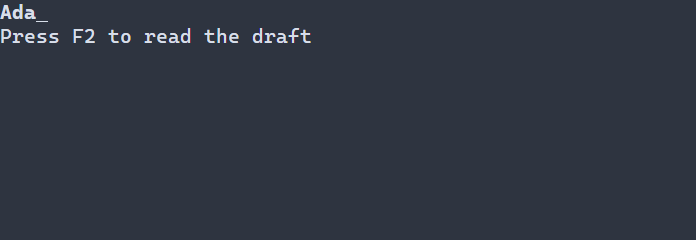
Line editor showing Ada and the draft-reading hint.
#include <portals/ui.hpp>
#include <utility>
int main() {
using namespace portals;
// clang-format off
return [] {
ui::Ref<LineEdit> name;
ui::Ref<Label> greeting;
auto scene = ui::scene(ui::vbox(
ui::lineEdit(name, "Ada", {.options = {.editMode = EditMode::EXPLICIT}}),
ui::label(greeting, "Press F2 to read the draft")));
return std::move(scene)
| ui::onKey("F2",
[name, greeting] {
})
| ui::onKey("F10", ui::quit);
} | ui::runApp();
// clang-format on
}
Typed Widget observation; explicit composite specializations reuse their existing weak facades.
Definition ui_ref.hpp:761
TextProperty text(TextResolver resolver={}, std::source_location origin=std::source_location::current()) const
Definition ui_ref.hpp:1968
@ EXPLICIT
Keep a draft until Enter or programmatic activation; focus loss preserves it.
Definition line_edit.hpp:30
The example reads the draft through name.text(), so F2 sees unconfirmed text too. To share a model between fields, pass the same ManagedScene::state(...) value to each; see declarative composition.
Configure the standalone guide examples, build target guide_line_edit, and run the resulting executable in a terminal. The source is shared with this page. For an installed SDK, see package setup.
cmake -S docs/examples -B build/guide-examples -G Ninja -DCMAKE_BUILD_TYPE=Release
cmake --build build/guide-examples --target guide_line_edit
./build/guide-examples/guide_line_edit.exe
For a loaded scene, declare LineEdit and obtain its typed reference as shown in scene loading. Callbacks remain C++ code. LineEditOptions and API specify the full contract.
| Setting | Default |
|---|---|
| Editing and display | IMMEDIATE, NORMAL, writable, no placeholder |
| Draft limits | 4096 bytes, 4096 bytes per cluster, 4096 graphemes, 8192 cells |
| History | enabled, 128 combined groups, 1 MiB of retained snapshots |
| Programmatic changes | RECORD in history |
Placeholder, protected display and Clear
Set LineEditOptions::displayMode and an optional owning placeholder when creating the field. This complete native form uses an internal model and reports setup/runtime failures through the ordinary runner. Clear returns its complete checked command receipt to the button adapter. F10 exits and restores the terminal; Ctrl+Z restores a cleared value while history is enabled.
#include <portals/ui.hpp>
int main() {
using namespace portals;
ui::Ref<LineEdit> password;
return ui::scene(ui::vbox(
ui::lineEdit(password, "", {
.options = {
.displayMode = LineEditDisplayMode::PASSWORD,
.placeholder = "Password"}}),
ui::button("Clear", [password] {
return password.clear();
})))
| ui::onKey(key::F10, ui::quit)
| ui::runApp();
}
@ PASSWORD
Render one ASCII '*' per grapheme, revealing its count; suppress outbound copy/cut.
Definition line_edit.hpp:36
Installed-package build. The same form is compiled as an installed consumer. No clipboard service is installed by default; an application can supply one through LineEditConfig::clipboard.
| Display mode | Value, selection and caret | Intrinsic width | Ctrl+C / Ctrl+X |
|---|---|---|---|
| NORMAL (default) | Actual graphemes, with ordinary selection and scrolling | Displayed text plus a caret cell | Existing clipboard behavior |
| PASSWORD | One ASCII * per extended grapheme, including selection and caret overlays | Mask length plus a caret cell | Consumed without a service call or result callback |
| NO_ECHO | No value glyphs or selection; focused caret stays at the leftmost cell | One cell, independent of value length | Consumed without a service call or result callback |
Layout constraints still determine the allocated rectangle. PASSWORD exposes the grapheme count, including one star for a combining sequence or an emoji ZWJ sequence regardless of its actual terminal width. Cursor/anchor remain byte offsets in the original UTF-8 draft. Protected copy/cut also leave history and invalidation unchanged. Inbound Ctrl+V and paste remain enabled when the editor is writable. Read-only blocks paste, edits and user Clear; disabled/hidden ancestry also blocks user commands. NORMAL still permits read-only copying. Explicit programmatic .text().set(...) keeps its existing behavior, including on a read-only editor.
An absent or empty placeholder shows nothing. A nonempty placeholder appears only while the draft is empty, both focused and unfocused, using the existing appearance and grapheme clipping. It never enters the model, validation, history, callbacks or clipboard. NO_ECHO keeps its fixed one-cell intrinsic width even when showing a prompt. Checked recipe mounting validates and prepares placeholder storage under the scene width policy and editor limits before publishing an internal model. Invalid UTF-8, line separators or over-limit text fail mounting; text failures preserve their typed payload, and allocation failures report NO_MEMORY. The direct low-level LineEdit constructor uses its documented exception convention instead.
Both options are immutable after mount. Change display policy by removing the editor and mounting a fresh binding, which starts fresh history. Destruction and remounting do not promise to overwrite old storage.
PASSWORD/NO_ECHO govern presentation and outbound clipboard handling. The application can still read plaintext through its model, TextProperty::get, text-source snapshots, LineEdit::text, commit receipts and undo history. History remains bounded and enabled by default (128 combined operations, 1 MiB of retained snapshots); history.enabled = false disables Undo, including for Clear. Built-in paint/cache commands and diagnostic exports omit the actual protected value; application callbacks/loggers remain the application's responsibility. Keep reference names, scopes and placeholder text nonsecret. No secure erase or zeroization is provided.
Ref<LineEdit>::clear() and low-level LineEditBinding::clear() create one separate user edit containing the previous draft and selection. Clear ignores the programmatic setter's RESET_BASELINE policy and follows the selected EditMode. An already-empty writable field is a strict no-op. Read-only/disabled fields return WOULD_BLOCK even when empty. Clear never adopts or overwrites a newer external model as a side effect.
Before draft acceptance, allocation/history/cache/invalidation failure preserves the old draft, selection and open typing group. After acceptance, a technical publication failure retains the matching empty draft/history/cache with dirty=true and the uncommitted model. The checked command returns the exact technical error. VALIDATION_FAILED and CONFLICT are semantic LineEditResult outcomes: the command receipt succeeds and the accepted draft remains undoable. A nonempty clear delivers one outcome. Return the complete EditorCommandResult from managed actions, as above, to keep report-once provenance; extracting .result() discards that receipt. Successful model commits and arbitrary user callback effects are not rolled back.
Reference: binding, publication and input
LineEdit owns a UTF-8 draft and exposes byte-boundary cursor and anchor positions. Its GraphemeText groups editing into complete graphemes, such as a letter with its combining accent. Terminal width and horizontal scrolling use cells. This includes emoji joined by a zero-width joiner (ZWJ) and Chinese, Japanese and Korean (CJK) text. Construct the widget, create a Property<std::string>, and retain the result of bindLineEdit for as long as input and observation should remain connected.
The tree, router and scheduler outlive the binding. The binding retains the model and optional clipboard service. Destroy or move it on the UI owner between frames. Widget text references borrowed through tree.read must not escape that callback. Render commands may borrow widget text until the enclosing tree.frame returns; the frame owner translates local commands and intersects the ancestor clip, as in the control gallery. Paint never reads the model, invokes a service or changes application data. Focus is a presentation snapshot supplied by the caller, while the router remains the authority for input eligibility.
Draft and model revisions
LineEditOptions::editMode selects when technically accepted text is validated and published. The default is EditMode::IMMEDIATE: input, deletion, clipboard cut/paste and fluent text changes publish valid changed candidates without Enter.
| Mode | Text change | Blur | Enter / programmatic confirmation |
|---|---|---|---|
| IMMEDIATE (default) | Validate and publish | Keep any rejected intermediate draft | Validate and confirm |
| ON_COMPLETION | Keep dirty draft | Validate and confirm once | Validate and confirm |
| EXPLICIT | Keep dirty draft | Keep draft | Validate and confirm |
For confirmation only on Enter or activation, select: LineEditOptions{.editMode = EditMode::EXPLICIT} or ui::lineEdit(model, {.options = {.editMode = EditMode::EXPLICIT}}). Programmatic router.invoke(field, {Action::ACTIVATE}) uses the same handler as Enter in every mode, delivering its exact LineEditResult to the result callback.
Technical text rejection preserves the previous draft and selection. Semantic validation false instead retains the new visible candidate with VALIDATION_FAILED and no model publication: a temporary empty string or minus sign remains editable. Validator/publication exceptions report typed FAILED outcomes and retain accepted text. Confirmation checks the original model revision both before and after the validator; CONFLICT never silently overwrites an external update.
Escape adopts the latest valid model in every mode. In IMMEDIATE it does not undo earlier successfully published changes. Successful immediate publication makes the draft clean and advances its baseline to the exact receipt's revision. A rejected/conflicting candidate remains dirty until confirmation or Escape.
Blur is synchronous at the existing router focus transition, before the next routed action; A→B→A before a frame still confirms A once. Model notifications and binding.sync are not synthetic blur events. Focus presentation still synchronizes before frames. Equal text does not cause another publication or redraw; explicit confirmation can return an unchanged PropertyUpdate receipt.
An external update refreshes a clean editor. A dirty editor retains its draft through external updates, queued notifications and explicit sync. Notification callbacks read the current snapshot rather than applying their possibly obsolete payload. Call sync before every frame because bounded notification delivery can be rejected. A successful commit remains successful when notifications are lost: LineEditResult::commit carries the exact PropertyUpdate<std::string> receipt. Do not retry the commit merely to deliver notifications.
LineEditResult::trigger identifies INPUT (including programmatic activation), FLUENT or BLUR independently of its status. Managed technical failures carry a lineEdit.input, lineEdit.fluent or lineEdit.blur breadcrumb when context allocation succeeds, and preserve their original typed cause and the editor's identity. A blur failure propagated through focus recovery in scene.prepare() is recorded once; unrelated prepare failures remain separate diagnostics. The existing managed stop policy is unchanged.
A validator or clipboard service can reenter UI code. The editor checks node lifetime after the callback, and Enter rechecks model revision after validation. Result callbacks run last and may remove the current node or an ancestor, or destroy the binding. Already committed application effects are never rolled back when such a callback throws. Mutation through sync during a frame or an active input operation returns WOULD_BLOCK. Wrong-thread synchronization is rejected.
Input and clipboard
- Left/Right, Home/End move by grapheme boundaries; Shift extends selection.
- Backspace/Delete remove complete selected or neighboring graphemes.
- Ctrl+A selects all; in NORMAL Ctrl+C copies and Ctrl+X cuts; Ctrl+V pastes in writable modes.
- The injected Clipboard service owns returned bytes and borrows copied bytes only for write. It must return promptly. A missing or failed service reports CLIPBOARD_FAILED; failed cuts never delete the selection.
- Paste remains data. Invalid UTF-8, CR, LF, U+2028 and U+2029 reject the entire operation with INVALID_TEXT. Other controls remain in logical storage and the renderer replaces unsupported clusters with ?; raw ESC/C0 bytes never become terminal commands.
- LineEditOptions::limits bounds the entire draft in bytes, cluster bytes, graphemes and cells. Exceeding any limit rejects the complete change with LIMIT_EXCEEDED; nothing is silently truncated. External models must satisfy the same limits and single-line policy; invalid snapshots leave presentation unchanged and sync reports INVALID_ARGUMENT.
Default input storage is limited to 4096 bytes. Clipboard reads receive that cap and their returned payload is checked again. Internal allocation failures report FAILED/NO_MEMORY. Failure before accepting text preserves the old draft; publication failure after acceptance keeps the new visible candidate without a model commit. Argument construction before an API call can throw. The software caret uses LineEditOptions::cursor, selection uses its own style, and a one-cell viewport displays a blank caret when the current wide glyph cannot fit. Scrolling never leaves half a glyph visible. The built-in themes reverse the focused field colors for the caret, keeping it visible over text and at the end of the draft in true-color and ANSI16 output.
Bounded editor Undo/Redo is enabled by default and shares the same admission, validation and model revision path. Mouse selection, IME composition and native clipboard implementations remain separate work.
See text ownership and Unicode policy, property notifications, focus and routing, and terminal ownership.
Styling reference
The natural selector is LineEdit. Paint uses normal, focused and disabled for the field, selected for selected text while enabled, and caret for the software caret while enabled and focused. header is not painted. The placeholder uses the field style. LineEditOptions::style is a ControlStyle; selection and cursor are CellStyle. Their manual defaults use terminal colors: selection is bold and italic; cursor is bold and underlined. PSS can override their five attributes through :selected and :caret; it does not change the placeholder or password mask text.
The common paint properties apply to each painted target:
| Property | Value |
|---|---|
| foreground | #RRGGBB text/ink color |
| background | #RRGGBB fill color |
| bold | true or false |
| italic | true or false |
| underline | true or false |
Manual ControlStyle defaults use terminal colors, normal text, bold focus and italic disabled text. Theme and PSS declarations override individual manual fields; unspecified fields retain lower-layer values, including explicit false. A selector without a state supplies all variants. See cascade and selectors and styles.
Layout properties width and height accept nonnegative cell counts, auto, fit-content, or flex(positive weight); min-width, max-width, min-height, and max-height accept nonnegative cell counts. They require selectors without state or :read-only; Except for min-width, these size declarations are runtime PSS only. Conflicting widget bounds reject the update and retain the previous style and geometry; constraints and recipe precedence are explained in layout. These affect allocation, not the glyphs themselves.
LineEdit { min-width: 16; }
LineEdit:focused { foreground: #ffffff; background: #245070; }
LineEdit:selected { background: #426080; }
LineEdit:caret { underline: true; }