Loading...
Searching...
No Matches
Show a virtual list
Use a virtual list for a large typed model when only visible rows should be formatted. VirtualListOptions defaults to a one-cell row and two overscan rows. Arrows and Home/End navigate; left press selects and the wheel scrolls. A typed reference observes the scene-owned view. For a loaded configuration, register a typed factory; the model and formatter remain C++ captures. See resource registration.
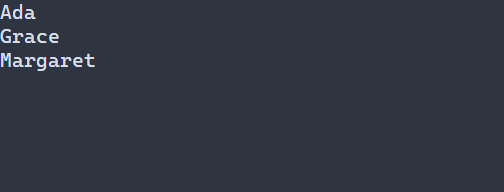
Three rows Ada, Grace and Margaret in the virtual-list example
Styling reference
Declarative lists use VirtualList; the managed virtual-view API defaults to List unless a target was supplied. A directly bound widget uses its registered target. Rows use normal or :selected, not focus or disabled variants. VirtualListOptions::normal and selected provide defaults beneath the cascade.
Use foreground, background (#RRGGBB) and bold, italic, underline (true or false). A rule without a state applies to all variants. See the cascade and size constraints; min-width is state-independent. Prepared match highlighting uses VirtualListOptions::highlight, not a PSS part: its present colors override row colors and its boolean attributes are ORed with the row attributes (by default bold and underline).
VirtualList:selected { background: #305070; bold: true; }
Use VirtualList<T>. The program below displays three names with standard keyboard and mouse navigation. Press F10 to close.
The program uses Names, an immutable ModelSnapshot<std::string> adapter with three records, and displayText, which creates GraphemeText. The adapter, helper, headers and complete program appear below and in guide_vlist.cpp.
Complete program
#include <array>
#include <portals/ui.hpp>
#include <stdexcept>
#include <utility>
using namespace portals;
public:
Names() : ModelSnapshot(1, 3) {
}
return {RangeState::READY, std::span(rows_).subspan(static_cast<std::size_t>(range.first), range.count), {}};
}
private:
const std::array<ModelRow<std::string>, 3> rows_{{{{1, 1}, "Ada"}, {{2, 1}, "Grace"}, {{3, 1}, "Margaret"}}};
};
GraphemeText displayText(std::string_view value) {
auto result = GraphemeText::from(value);
if (!result) {
throw std::runtime_error("Invalid display text");
}
return std::move(*result);
}
int main() {
using namespace portals;
// clang-format off
return [] {
auto scene = ui::scene([](ManagedScene &owner) {
return displayText(row.value);
});
});
});
return std::move(scene)
| ui::onKey("F10", ui::quit);
} | ui::runApp();
// clang-format on
}
Owning validated UTF-8 and immutable extended grapheme measurements.
Definition text.hpp:145
static std::expected< GraphemeText, TextError > from(std::string_view bytes, WidthPolicy policy={}, TextLimits limits={})
Validate, segment and measure a single logical UTF-8 buffer.
Additive lifecycle owner over one existing Application subtree. UI affine and nonmovable....
Definition managed.hpp:530
std::expected< ManagedModel< T >, ManagedError > model(std::shared_ptr< const ModelSnapshot< T > > initial, ModelOptions options={}, ManagedViewHandler< T > prepared={})
Create a scene-owned model and a weak typed UI handle.
Definition managed_views.hpp:65
Immutable list/table provider storage, independent of view/source lifetime. Implement read as bounded...
Definition model.hpp:94
@ READY
Exactly the requested immutable rows are available.
Definition model.hpp:47
A typed domain row and its stable identity; a table uses a typed record as T.
Definition model.hpp:55
Half-open logical row interval; arithmetic is checked before provider access.
Definition model.hpp:35
The standalone guide project builds target guide_vlist; run the resulting executable in a terminal. It links portals::core.
The scene owns input bindings, range consumers and preparation. The formatter returns owning text and only reads the supplied row. Ready in-memory data needs no provider callback. Pending data requires prepared in ui::VirtualListConfig<T> to dispatch the returned request; the library starts no workers. TBD: the requested ui::vlist alias is unavailable; no delivery date is assigned.
Terms: recipe, frame, ownership.
API reference and constraints
VirtualList<T> is one SizedWidget, regardless of the logical row count. It consumes the typed immutable model, uses the existing router, and paints widget-local commands through the regular layout and frame contract. It does not create a widget for each row.
Owning data and preparing a frame
Create a separate ModelConsumer<T> for every view. Pass it by move to the list together with an owning, copyable formatter.
T need not be default-constructible or copyable. The list only borrows each const ModelRow<T>& during formatting. Providers guarantee immutable reachable storage, stable nonzero RowId pairs, and consistency within a data revision. The formatter must return owning GraphemeText under options.width_policy; it must not retain the row reference, perform I/O, launch work, or mutate the tree/model. Captures are owned by the list and destroyed on UI.
Between frames, the application applies Scheduler publications, obtains one model pin, an immutable capture of data and availability, and passes that same ModelFrame<T> to every view of the model. prepareVirtualList(tree, list, pin, viewport) takes the final local size of that view, in integer cells. Determine it from application/layout constraints; repeat preparation after resize before painting. This preparation phase precedes the tree.frame that performs layout, paint and rendering. A mismatch between arranged and prepared sizes returns INVALID_GEOMETRY; unprepared or changed scroll/options state returns WOULD_BLOCK from paint. Never render a partial command collection after any paint failure.
The view retains its pin and ModelRange<T>, and owns every formatted string. A preparation builds the entire next presentation before publishing it. An allocation/delegate failure preserves the previous frame, row identities and text together. Successful replacement releases old owners only after the new state is consistent. Paint neither pins nor reads a model and never formats. Borrowed TextCommand text remains alive through rendering inside the enclosing tree.frame; do not retain commands after that frame. The output owner can submit the resulting owning framebuffer to FrameWriter afterward.
A provider completion may contain a bounded prefetched page around the requested interval. During later preparation the view can read the new exact window from its retained completion snapshot when both data revision and row count match the current pin. It retains one such owner, formats only current visible rows, and respects the model's read budget. A cache miss remains pending and schedules the new exact request; provider failures are not replaced by older ready data. A revision change or hidden view releases the old prepared owner. Public base reads and independent consumer results retain their existing exact semantics.
Range and request rules
For a positive fixed row height H, the list realizes ceil(viewport.height/H) rows, including the last partial row. Zero width/height and an empty model realize zero rows. The first row is integral and clamped to the last logical row; the empty model uses zero. Up to overscan_rows extra rows on each side enter the requested range, but only visible rows are formatted. There is no million-row allocation, total-height multiplication, row-ID scan or hidden worker.
Preparation first checks the consumer result in the supplied frame. A matching ready/error result belongs to that consumer. Otherwise it performs a bounded in-memory frame.read and, while pending, checks its own completed page owners. These reads cannot initiate I/O. The whole requested interval must be ready: this version does not spatially merge a partially ready overscan. Pending rows show ..., error rows show !, clipped as whole graphemes. rangeState() exposes the readiness independently of those placeholders. The provider's detailed error remains available through the model's range API.
A new pending range produces optional<ModelRequest<T>> once, as a dispatch receipt. The application starts its own work using that token; repeated preparation of the same pending request does not return another receipt. A worker calls token.complete(snapshot) and checks its result. Queue backpressure (WOULD_BLOCK) permits retrying the same completion token. If the application cannot start work, it cancels and releases its receipt; preparation can then issue a fresh one. A provider error is stable until a new publication or explicit retryVirtualList(tree, list) followed by preparation. No automatic retry loop is installed. Check Model::lastError() when applying Scheduler publications: queue acceptance alone does not prove application to the model.
Scrolling supersedes the previous request; the existing model consumer checks request generation and data revision when completions arrive. Cancelling the token does not join a worker or free its work reservation while other owners remain. If the model's in-flight budget is full, preparation returns WOULD_BLOCK; release completed/cancelled application tokens and retry. The configured model range limit also applies to viewport plus overscan; oversized ranges fail with INVALID_ARGUMENT, without silently reducing the requested viewport.
Selection, input and visibility
Selection is optional<RowId>, not a row position. Insertion, reordering, publication and scrolling do not replace it. Removed IDs remain selected until the application clears/changes them. setVirtualListSelection accepts an offscreen nonzero ID without loading or searching the model.
Keep the ActionBinding returned by bindVirtualList alive. Up/Down move within the logical model; Home/End reach its boundaries. With no selection in the visible range, Up/Down start at the first visible row. Finding an already selected row examines only visible delegates. A navigation intent is a separate position plus data revision; a later explicit selection cancels it, and a data revision change discards it. Only ready rows from the applicable preparation resolve that intent to a stable ID. Pending input can continue scrolling.
Left press uses the router's actual surface geometry and ancestor clip. It maps the hit cell to a logical row using fixed row height; stale dirty content is not clickable. Wheel up/down moves the first row by one without changing selection. Fractional input, identity anchoring and ensure-visible use the shared scroll component. Providers opt into stable anchoring by implementing bounded ModelSnapshot::locateRow; unsupported providers retain ordinal scrolling. The view never scans the full model. Device acceleration remains an input-adapter concern.
Preparation inspects ancestor visibility. Hidden lists cancel work, release their prepared delegates/frame, clear navigation intent, and keep stable selection. Call preparation after a visibility change even if the view will not paint. Tree removal destroys the consumer and cancels its work independently. Disabled views still paint, but the router prevents their input.
Errors, invalidation and limits
All view mutation uses the tree's UI owner and occurs outside a frame. Wrong thread, stale/foreign node, closed tree, and frame mutation errors propagate. Nonpositive row height, negative preparation dimensions, invalid IDs/policies, and range overflow return INVALID_ARGUMENT. Allocation failures return NO_MEMORY; other formatter exceptions return CALLBACK_FAILED. A foreign model pin returns STALE_NODE for the consumer even if publication revisions coincidentally match. A failed sink may already have accepted earlier row commands; the caller discards that scene.
Preparation invalidates paint when it changes the presentation. Repeating an unchanged preparation neither reformats rows nor schedules a frame. Selection, scroll and explicit retry invalidate paint; options invalidate layout and paint. Application-driven model publication already invalidates its model context. Row text and placeholders use the complete configured width policy, and the renderer preserves whole wide graphemes even in a one-cell viewport.