Loading...
Searching...
No Matches
Keep text positions through edits
Русская версия · Model bookmarks · Undo and redo
A text bookmark records a position in a logical document. Inserting text before that position moves the bookmark with the original text. The document owns its selection and Undo/Redo history, so replacing a view does not reset them.
Try a finite document
Include <portals/ui_text_document.hpp> to declare a finite in-memory document and bind ordinary labels to it. The optional header is separate from ui.hpp. This example displays two views of the same document and a caret marker:
// Copyright (c) 2026 ttldtor.
// SPDX-License-Identifier: BSL-1.0
#include <portals/ui.hpp>
#include <portals/ui_style.hpp>
#include <portals/ui_text_document.hpp>
#include <format>
#include <string>
using namespace portals;
int main() {
auto note = ui::finiteTextDocument("Hello world");
constexpr std::size_t WORD_START = 6;
auto word = note.bookmark(WORD_START);
return std::format("Caret: {} | {} | {}", value.selection.cursor, value.dirty ? "modified" : "saved", value.target);
};
// clang-format off
return ui::scene(ui::vbox(LinearOptions{.gap = 1},
ui::label("The bookmark follows world when text is inserted before it."),
ui::vbox(
ui::label(note),
ui::label(note.source(), [](const ui::TextDocumentValue &value) {
return std::string(value.selection.cursor, ' ') + "^";
})).framed("rounded", "Document and caret"),
ui::label(note.source(), position),
ui::hbox(LinearOptions{.gap = 1},
ui::button("Insert prefix", [note] { return note.insert(0, "Hi, "); }),
ui::button("Find bookmark", [note, word] { return note.restore(word); }),
ui::button("Undo", [note] { return note.undo(); }),
ui::button("Redo", [note] { return note.redo(); })),
ui::hbox(LinearOptions{.gap = 1},
ui::button("Savepoint", [note] { return note.savepoint("memory:note"); }),
ui::button("Savepoint as copy", [note] { return note.savepoint("memory:copy"); })),
ui::label(note).minWidth(40).framed("rounded", "Shared document"),
ui::label("Savepoints are in memory. This example does not write files."),
ui::label("F2: savepoint | Ctrl+Z: undo | Ctrl+Y: redo | F10: quit"))
.maxWidth(84).fitHeight().framed("rounded", "Text anchors"))
| ui::theme(nordTheme())
| ui::onKey("F2", [note] { return note.savepoint("memory:note"); })
| ui::onKey("Ctrl+Z", [note] { return note.undo(); })
| ui::onKey("Ctrl+Y", [note] { return note.redo(); })
| ui::onKey("F10 | Ctrl+C", ui::quit)
| ui::runApp();
// clang-format on
}
StyleSheet nordTheme()
Owning finite-document presentation; never a window into an arbitrary file.
Definition ui_text_document.hpp:15
Build with C++23 and link portals::core, following Connecting an application. Click Insert prefix, then Find bookmark. Both views show Hi, Hello world; the bookmark restores the caret before world, now at byte offset 10. Undo and Redo restore text and selection together. The caret marker uses ASCII text so its byte offset also matches its display column.
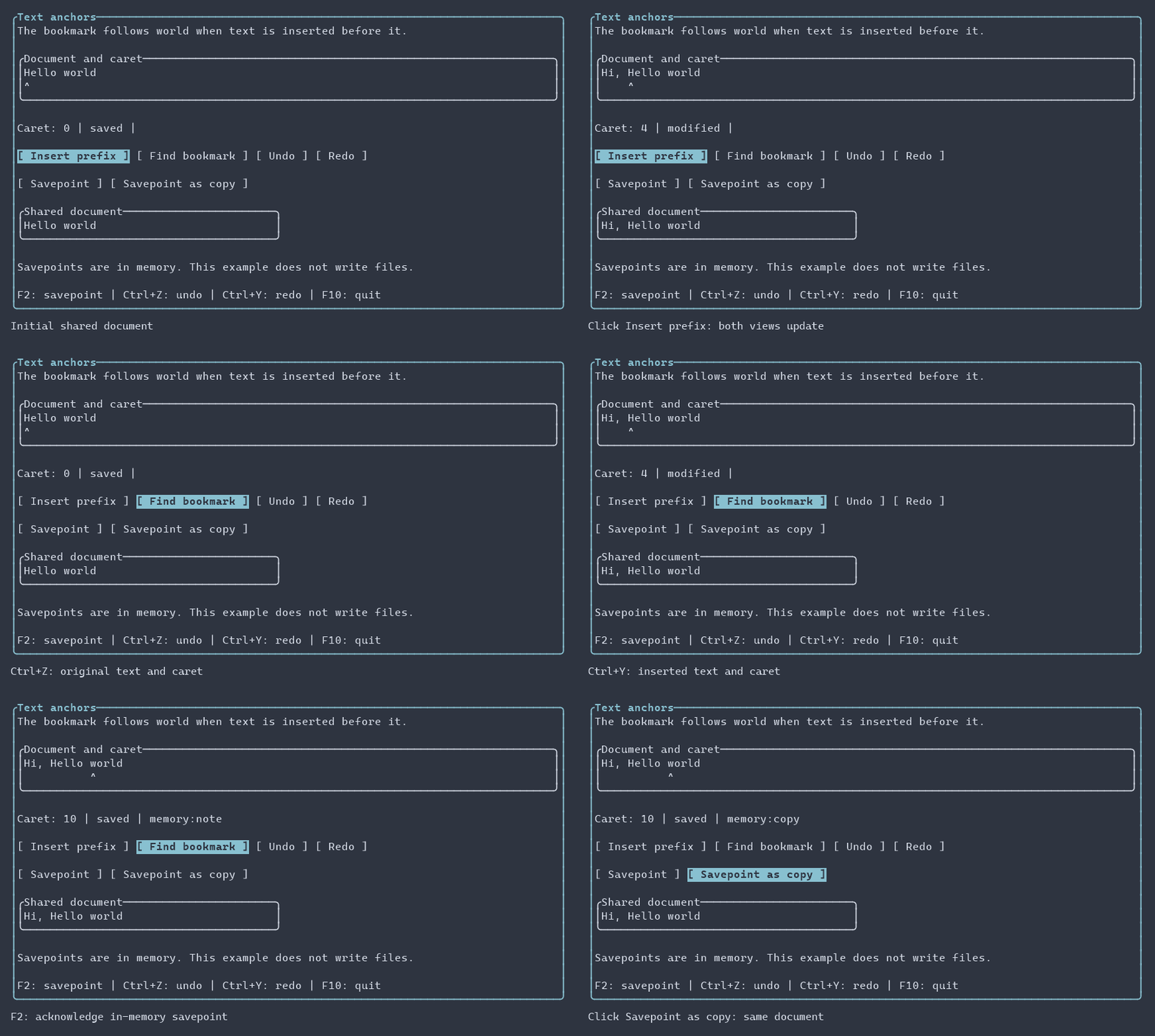
A shared finite document: edit, restore a bookmark, Undo, Redo and savepoints
Savepoint and Savepoint as copy acknowledge an in-memory baseline named memory:note or memory:copy. This program performs no file writes. Saving under another destination preserves the logical document, bookmarks and history. F2 creates the first savepoint; Ctrl+Z and Ctrl+Y navigate history; F10 exits.
Bounds and execution context
The UI factory defaults to 4096 UTF-8 bytes and 4096 graphemes, with the existing finite text limits. Pass FiniteTextDocumentOptions explicitly to select other finite limits. Each text edit segments the admitted buffer and uses the existing bounded snapshot history. Each presentation value owns the complete finite text. These costs depend on the admitted text size; this adapter is suitable for small documents and demonstrations of session behavior.
Copies of ui::FiniteTextDocument share one document and its read-only source(). ui::label(note) displays its text; ui::label(note.source(), formatter) projects selection, dirty state or destination metadata. Commands belong on the creating UI thread. The source binds to one scene; replacing views in that scene preserves the session. After scene close or destruction, commands report CLOSED. Writing through a field of the presentation source is rejected. Use document commands to update text and selection consistently.
The core accepts an edit before publishing its UI presentation. A failed allocation or rejected notification during publication can leave the accepted document newer than the visible labels. The checked command reports that failure; after handling its cause, call refresh() to retry publication. No rollback of an already accepted core edit is promised. lastError() retains a typed core TextDocumentError when the core operation itself failed. Checked command results can be returned directly from a button or key handler for runApp to report.
Byte offsets and grapheme boundaries
portals::FiniteTextDocument is the UI-independent finite adapter declared in <portals/text_document.hpp>. Its replace, setSelection and bookmark coordinates are UTF-8 byte offsets at extended grapheme boundaries, including the end of the text. They are neither display columns nor grapheme ordinals. Caller code serializes access. A borrowed text() view expires on successful text mutation or document destruction.
PositionAffinity::FORWARD keeps a mark after an insertion at that mark; BACKWARD keeps it before the insertion. Unicode edits can merge clusters and remove an old boundary. Resolution snaps to the end or beginning of the current cluster according to affinity and returns NEAREST. Undo that restores a known content state can recover the original exact boundary.
The core implements PositionResolver: submit a qualified PositionRequest and check the PositionReply before applying it. A bookmark carries no write authority. Missing retained change proof returns UNAVAILABLE; a foreign resource or incompatible lineage cannot be silently restored.
Acknowledge a real save
For an actual writer, call beginSave(target) and retain the bytes observed at that ticket's revision using the application's own snapshot or serialization mechanism. The ticket owns destination metadata and qualification; it does not own the document bytes or perform I/O. Run storage I/O outside the UI thread and call acknowledgeSave(ticket) on the owner thread only after that write succeeds.
An acknowledgement for an older content state does not clear newer dirty edits. A ticket older than an already acknowledged save reports STALE. SaveAs changes destination metadata and the acknowledged savepoint while preserving selection, logical identity and Undo/Redo. dirty() compares the current content state with the acknowledged one, so Undo/Redo can return to the saved state.
On the core portals::FiniteTextDocument, report an external replacement with observeExternalReplacement(). The document enters a conflict state; it does not silently adopt external bytes. Explicit acceptExternalReplacement(text) validates the new baseline, advances lineage and clears incompatible history and marks while retaining logical identity.
Supply anchors for a large text provider
TextChangeMap is a bounded metadata helper for providers with their own storage, history and Unicode boundary lookup. TextSplice records an edit in provider-defined scalar units. The helper stores no document text, performs no I/O, and does not require a global grapheme index. Its capacity defaults to 128 retained changes. The provider must report every edit truthfully and serialize map operations.
map(bookmark) returns an intermediate TextMappedPosition. Before returning a general TEXT position reply, the provider must validate or snap its scalar offset to a current grapheme boundary. An exact scalar mapping alone cannot prove a Unicode boundary. traverse receives a content-state token and extent proven by the provider's existing Undo/Redo engine; the map does not create a second history store.
This foundation does not add windowed text editing, a file writer, or automatic LineEdit/TextArea binding. Such a provider can use the same general bookmark contract while loading only the data needed to qualify the requested boundary. The finite demonstration does not claim arbitrary-size editing.