Loading...
Searching...
No Matches
Diagnostics
The final | ui::runApp() stage provides default error handling. It checks scene setup/run failures, attempts cleanup and terminal restoration, then prints an error to stderr and returns 1. Managed recoverable action errors are retained; a successful run can report a bounded error summary and still return 0.
Error reports in stderr
You can select the standard final report sink explicitly with | ui::reportOnError():
#include <portals/ui.hpp>
int main() {
using namespace portals;
ui::Ref<Button> exit;
return ui::scene(ui::button(exit, "Exit"))
| ui::reportOnError()
| ui::onClick(exit, ui::quit)
| ui::onKey("F10", ui::quit)
| ui::runApp();
}
Typed Widget observation; explicit composite specializations reuse their existing weak facades.
Definition ui_ref.hpp:761
The sink is called after terminal restoration and cleanup were attempted. A clean run with no retained errors does not call it. ui::runApp() uses this sink by default, so the explicit stage is optional. With a custom sink installed, ui::reportOnError() restores standard stderr reporting.
Finding a cause by symptom
The first application already uses default error handling through ui::runApp(). You do not need to install a separate handler to start.
| What happened | What to check | Next action |
|---|---|---|
| The scene did not open and the application returned 1 | The final stderr report identifies the operation, source and error cause | The reported configuration or file needs correction. A final report sink can write to your own log |
| A button does not invoke its action | Can Tab focus it, is it enabled, and is its reference passed to ui::onClick? | You can compare registration with step 2 of the first application and try Enter on the focused button; see focus and routing for dispatch order |
| The handler ran but the display did not change | Does the value change, and are you updating the intended control? Assigning an equal value again may require no frame | The value and assignment target are a useful starting point. Causal diagnostics can then follow the action |
| A shortcut or key release does not arrive | Does the terminal intercept the shortcut, and does the input path provide the requested phase? | An ordinary F2 press provides a baseline. The input guide lists supported keys and phases; see the terminal table for observed conditions |
| Styling does not change a control | Does the selector match the type, ID and state? Does a higher-priority layer override the rule? | PSS selectors and properties, then layer precedence, explain rule matching. A styleFile path resolves from the process working directory |
| Access through a Ref returns CLOSED, STALE_NODE or WRONG_THREAD | Are the scene and target control alive, and does the operation run on the UI thread? | Access requires a reference to a live control on its scene thread. Explicit reads require checking the returned expected; see control references |
| An error did not appear in the log file | Is a custom sink connected, and was there an error? A clean run does not call reportOnError | The final report sink can write to a file. onError provides live observation; terminal output should wait until the UI ends |
| Terminal modes remain changed after exit | Did the runner report a restoration failure, or was the process terminated forcibly? | Retaining the report and opening a new terminal session allow further inspection. A normal repeat run can check mode restoration |
portals_terminal_probe runs separately, after the application has closed. It checks the environment and DA/CPR replies; it does not test delivery of every key. See how to read probe results.
A custom final report sink
ui::reportOnError(sink) accepts a function receiving const ui::SceneReport &. You can write to your file or logger directly in this callback. Calling ui::reportToStderr(report) there is also safe: terminal restoration and cleanup have already been attempted. You can pass that function directly:
| ui::reportOnError(ui::reportToStderr)
ui::reportOnError(sink) replaces the final sink; an empty sink restores stderr. Delivery happens once after restoration and cleanup were attempted. A throwing sink falls back to stderr with the original report. The callback borrows the report only for its call; retaining it requires a copy. Reentering or mutating the scene from that callback is prohibited.
Observing errors while the UI runs
ui::onError([](const ManagedDiagnostic &error) { ... }) installs a UI-thread observer for individual typed errors. It does not replace the final sink or veto an error. The observer can store bounded application data or update your own state. Output to stdout/stderr should wait until the terminal is no longer active. Nested reports suppress recursive notification, and observer exceptions are recorded separately from the original cause. ManagedScene::diagnostics() returns an owning history snapshot; drainErrors() transfers the retained history. See managed_diagnostics.hpp for error fields and limits.
Low-level APIs returning expected still require explicit checks. Exceptions inside documented runner/managed callback boundaries become typed errors. Arguments, captures and coroutine frame construction can throw before entering those boundaries. For a checked description-factory entry, use the callable ui::runApp(factory, ...) overload in ui.hpp.
There is no automatic persistent log, log rotation or background logging service. That integration is TBD, with no assigned milestone in the current feature plan. The final sink is the available extension point.
Trace why an action did not change the display
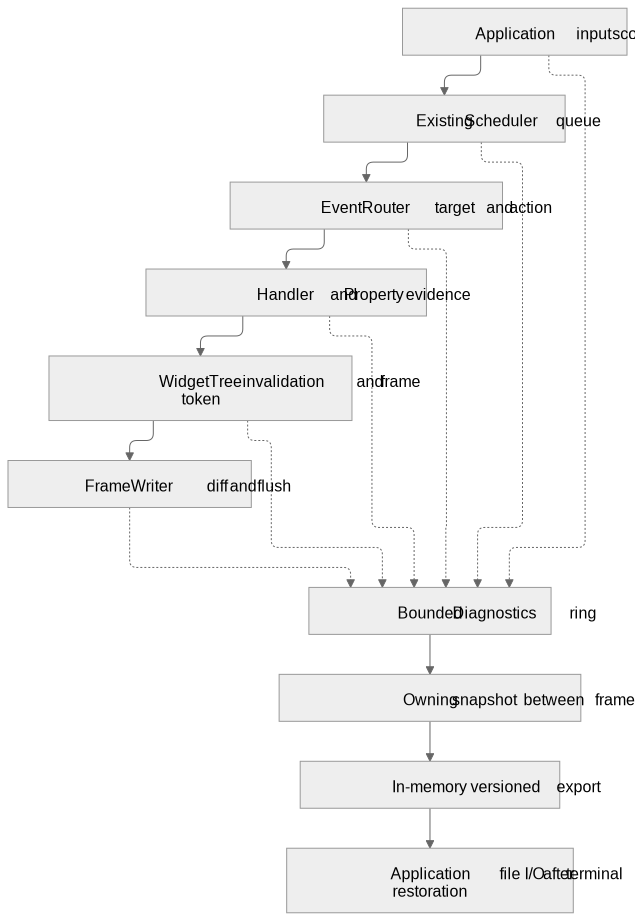
Diagnostics records bounded causal metadata; it is opt-in and disabled by default. It is separate from managed error history and your logger. Share one recorder through SchedulerOptions::diagnostics (or ui::SceneOptions::application.scheduler.diagnostics when using a scene), enable it with a checked enable call, then disable/snapshot/export after the run. exportDiagnostics returns text in memory; your application owns file I/O and its errors.
Causal recorder reference: propagation, bounds and export
Portals records bounded metadata to explain an input action, including an action that returns without requesting a frame. It does not record input characters, paste or clipboard contents, property values, exception messages, object addresses, or VT bytes. This metadata is not the PORTALS-TRACE 1 replay format.
Connect one recorder
Diagnostics is disabled by default. A null recorder costs a pointer check at a hook; a configured but disabled recorder adds an enabled-state check. Disabled hooks do not allocate ring memory, format text, read clocks, increment diagnostic counters, or inspect input/model payloads. Queue entries have fixed-size token storage even while recording is disabled. Enabling reserves the ring; recording never allocates. There is no diagnostic clock: sequence numbers order retained observations, rather than claiming wall-clock latency. Scheduler's existing clock and queue metrics retain their original semantics.
The scheduler shares ownership with its endpoints. The tree borrows the scheduler; the writer shares the recorder. DiagnosticScope only borrows it, must remain on its constructing thread, and must end before the recorder. Scopes restore nested contexts on normal and exceptional exits. There is no process-wide recorder or second executor.
Follow actual input and frames
The input token is created at the application's decoded input boundary, before attempting publication, including input subsequently rejected by a full queue. A DiagnosticScope around publication installs trace->beginInput(DiagnosticInput::KEY).
The scheduler retains a token with the publication and installs it around the UI callback. Router target selection, focus changes, semantic action resolution, handler entry/return, Property equality/commit, and tree invalidation use this same context. Direct router dispatch/invoke creates its own input scope when none exists. An application continuation on another thread can install a copied token with DiagnosticScope; a new beginInput inside a scope explicitly records its parent. The context contains no UI pointer and never grants access to a widget.
After bounded scheduler dispatch, the application consumes the ordinary frame request, renders the actual tree, then submits the result with tree->diagnosticFrame() as its token.
Multiple invalidations coalesce into one frame ID. Each cause writes its own ring record referring to that frame; no growing list is attached to the tree. The frame token identifies the first recorded cause, not every cause. Layout's paint-dirty mark inside an active tree frame belongs to that frame and does not invent another diagnostic frame request. The output records describe actual FrameWriter diff, submission and flush results. output_accepted means complete, consistent transport acceptance; it is not proof that a physical terminal displayed the frame.
Interpret evidence conservatively
A synthetic Enter on a focused Button whose callback calls Property::set with an equal value produces these stages (numeric IDs omitted):
input input=key
queue_accepted queue=control
queue_dispatch queue=control
action action=1
target stableNodeId=<tree-session>:<slot>:<generation>
handler_started
property reason=value_unchanged
handler_returned reason=value_unchanged
frame_not_requested reason=frame_not_requested
completed reason=value_unchanged
queue_returned reason=outcome_unknown queue=control
value_unchanged describes the observed Property operation. It does not assert that arbitrary external state was unchanged. A user callback without Property evidence remains outcome_unknown, even when it returns normally and requests no frame. A later handler_failed cannot undo an earlier value_changed observation. frame_not_requested means that this routing scope observed no new tree frame request, not that the application had no previously pending frame.
Known reasons include queue_full, replaced, cancelled, no_target, target_disabled, stale_target, unbound_action, unhandled, handler_failed, value_unchanged, outcome_unknown, frame_not_requested, diff_empty and output_failed. An empty explicit target differs from an ineligible explicit target. Keyboard focus recovery can select another eligible target; diagnostics reports what the router actually selected. Node session, slot and generation are exported together, without addresses. IDs are local to the recorder/tree lifetime, not portable identities across application runs.
A replaced publication records both the old publication's cancellation and a fixed-size link from the new publication. Queue metrics are unchanged. The export cannot establish why input never reached an instrumented application boundary.
Bounds, periods and incomplete chains
enable starts a fresh interval and clears its ring/loss counters. Sequence and identity counters never reset or wrap. disable preserves the retained interval and its final sequence. A context carried across either boundary is incomplete. Identity exhaustion permanently stops admission with identity_exhausted.
The ring overwrites its oldest record when full (dropped_overflow). Producers try the record lock once and count contention losses (dropped_contention) rather than blocking the UI or changing delivery. Snapshot copying holds the lock; format and I/O do not. Snapshot memory is bounded by configured capacity. Snapshot analysis uses bounded scans of retained records; reserve large capacities with care because completeness analysis is quadratic in capacity in the worst case. Capture between frames, not in measure/layout/paint.
The snapshot exports interval boundaries, retained sequence range, both loss counters, saturation, state and incomplete. Any known loss conservatively taints all retained chains. Missing input/completion, outstanding publication/output and cross-period tokens are also incomplete. Each accepted publication needs its own queue_returned or queue_cancelled; entering its callback or finishing another publication with the same correlation ID does not complete it. A failed callback records queue_returned reason=handler_failed at the scheduler boundary. This is deliberately conservative: an absent record is never proof that an action did not happen. No accounting is performed for disabled hooks.
Export without damaging a TUI
exportDiagnostics(snapshot) returns schema-versioned text in memory; it performs no file, stream, or terminal I/O. The application chooses a file and owns error handling. Capture/serialize between frames, or after the terminal has been restored. Never send the text to stdout/stderr while a native TUI is active.
Snapshot construction and return preserve std::bad_alloc propagation, including Debug iterator-proxy allocations. The return uses a bounded copy outside the lock to avoid a potentially allocating noexcept container move. Allocation/formatting errors remain visible to the caller; file open, write and close errors must all be checked. validateDiagnosticVersion rejects unsupported version headers before an application's reader interprets fields; it is a version check, not a replay parser. Applications choose their own export presentation and file-error policy.
Implemented flow