Loading...
Searching...
No Matches
FindBar
Русская версия · LineEdit · Control examples
Use FindBar to navigate literal matches in a bounded document, an immutable model, or a streaming Viewer source; it does not edit or persist the source. See FindBar limits and API. The complete examples below show both the document and model paths.
FindBar combines a one-line query editor, Previous/Next/Clear buttons and a summary of the accepted query's results. The document overload owns one bounded UTF-8 document and searches it synchronously. The model-backed overload searches an immutable model snapshot on a worker. The first program below uses the document overload; a second loads that control from scene text.
Ordinary C++ program
Build portals_find_bar_example with examples enabled, then run it in a terminal. Type a literal query and use the built-in buttons or F3 and Shift+F3 to move through results. Both navigation directions wrap over the stored results. F10 exits through the standard runner.
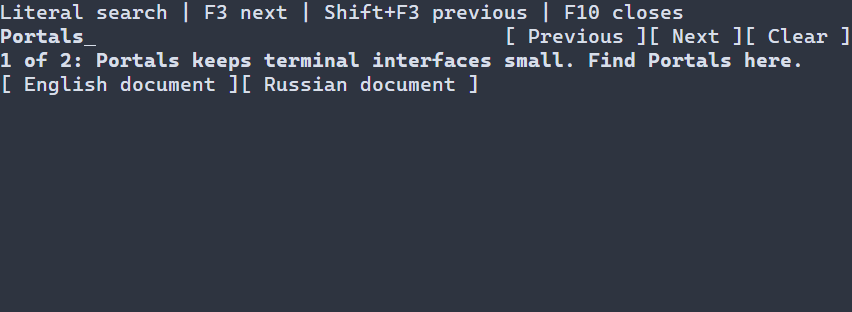
Literal search composition with a query, navigation buttons and match count.
// Copyright (c) 2026 ttldtor.
// SPDX-License-Identifier: BSL-1.0
#include <portals/ui.hpp>
#include <portals/ui_style.hpp>
#include <string_view>
using namespace portals;
int main() {
constexpr std::string_view INTRODUCTION =
"Portals keeps terminal interfaces small. Find Portals here, then find Portals again. "
"Unicode stays whole: cafe\u0301, 界 and 👩💻.";
constexpr std::string_view TRANSLATION =
"Портал открывает документ. Другой портал показывает результат. "
"Поиск точный: портал и Портал — разные запросы.";
ui::Ref<FindBar> find;
auto browser = ui::scene(ui::vbox(
ui::label("Find in a small document | F3 next | Shift+F3 previous | F10 closes"),
ui::label("Type a literal query. The bar shows its count and the selected context."),
ui::findBar(find, INTRODUCTION),
ui::hbox(
ui::button("English sample").onClick([=] {
find.document(INTRODUCTION);
}),
ui::button("Russian sample").onClick([=] {
find.document(TRANSLATION);
}),
ui::button("Find Portals").onClick([=] {
find.text() = "Portals";
})),
ui::label("Previous and Next wrap. Clear empties the query; Ctrl+Z restores the draft.")));
// clang-format off
return std::move(browser)
| ui::style(".find-bar-summary { bold: true; }")
| ui::onKey(key::F3, [=] {
find.next();
})
| ui::onKey(key::SHIFT + key::F3, [=] {
find.previous();
})
| ui::onKey(key::F10, ui::quit)
| ui::runApp();
// clang-format on
}
Typed Widget observation; explicit composite specializations reuse their existing weak facades.
Definition ui_ref.hpp:761
TextProperty text(TextResolver resolver={}, std::source_location origin=std::source_location::current()) const
Definition ui_ref.hpp:1968
bool next(std::source_location origin=std::source_location::current()) const
Definition ui_ref.hpp:2085
bool document(std::string_view bytes, std::source_location origin=std::source_location::current()) const
Definition ui_ref.hpp:2142
bool previous(std::source_location origin=std::source_location::current()) const
Definition ui_ref.hpp:2097
The sample keeps both documents in the program and changes the source through the control. It does not read or write files. The Russian sample also makes case sensitivity visible: портал and Портал are different queries.
Loading the control from a scene resource
The resource version declares FindBar by its built-in name. C++ obtains the typed reference and connects two ordinary button handlers to replace the document and query. A resource does not declare executable callbacks.
// Copyright (c) 2026 ttldtor.
// SPDX-License-Identifier: BSL-1.0
#include <portals/ui.hpp>
#include <portals/ui_style.hpp>
int main() {
using namespace portals;
constexpr auto ENGLISH = "Portals keeps terminal interfaces small. Find Portals here.";
constexpr auto RUSSIAN = "Портал открывает документ. Другой портал показывает результат.";
auto scene = ui::scene(R"scene(
scene {
VBox {
Label { "Literal search | F3 next | Shift+F3 previous | F10 closes" }
FindBar#find { document="Portals keeps terminal interfaces small. Find Portals here." text="Portals" }
HBox {
Button#english { "English document" }
Button#russian { "Russian document" }
}
}
}
)scene", {.format = ui::SceneResourceFormat::CONFIGURATION});
return scene
| ui::style(".find-bar-summary { bold: true; }")
| ui::onClick(englishButton, [=] {
find.document(ENGLISH);
find.text() = "Portals";
})
| ui::onClick(russianButton, [=] {
find.document(RUSSIAN);
find.text() = "портал";
})
| ui::onKey(key::F3, [find] { find.next(); })
| ui::onKey(key::SHIFT + key::F3, [find] { find.previous(); })
| ui::onKey(key::F10, ui::quit)
| ui::runApp();
}
One-line button; registration is an explicit caller-owned ActionBinding.
Definition controls.hpp:161
Retained query/navigation/count composition over owning document or model search results....
Definition find_bar.hpp:118
DynamicRef get(std::string_view name, std::source_location origin=std::source_location::current())
In CONFIGURATION resources, FindBar accepts document, text, maxDocumentBytes, maxMatches, previousLabel, nextLabel and clearLabel. It also accepts the ordinary editor settings editMode, readOnly and nested limits (maxInputBytes, maxClusterBytes, maxGraphemes and maxCells). The defaults are an empty document and query, a 65,536-byte source limit, 4,096 stored matches, the captions “Previous”, “Next” and “Clear”, IMMEDIATE mode, editable input and query limits of 1,024 input bytes, 1,024 cluster bytes, 1,024 graphemes and 2,048 display cells. The hard source, query-byte and stored match ceilings are 1 MiB, 16 KiB and 65,536 respectively.
Both forms use the standard scene runner. No client-side control registration, terminal emulator, replay loop or persistent storage is involved.
Matching and result limits
Matching is exact, case-sensitive UTF-8 byte matching, with both ends of each accepted result required to be boundaries in the source's grapheme segmentation. The control does not normalize Unicode: canonically equivalent strings such as é and e followed by a combining acute accent remain distinct. It does not case-fold, use locale rules, or apply regular expressions. A query is one line and follows the normal LineEdit input policy. Source text may contain line breaks (including CRLF) and tabs. The preview applies the terminal text policy to control clusters and shows placeholders where appropriate; it is not a multiline or tab-expanded viewer.
Overlapping matches count. In aaaa, the query aa has three results, starting at byte offsets 0, 1 and 2. An empty query and a query with no matches are normal states with no selected match. A newly accepted query selects its first result. Navigation wraps only through retained results.
The default source limit is 65,536 bytes and the default stored-result limit is 4,096. The control retains the first results and detects whether another valid match exists; when so, it reports a truncated count and does not claim an exact total. Hard ceilings are 1 MiB for source bytes, 16 KiB for query bytes and 65,536 stored matches. A configured limit above its hard ceiling is invalid. Query byte, grapheme, cluster and display-cell limits come from the ordinary editor configuration; its default byte limit is 1,024. The zero source limit admits only an empty document, and the stored-match limit must be positive.
Source bytes are admitted before FindBar copies them. A scene resource parser or external text resolver may already have allocated its input before the control can apply its own limits. Invalid UTF-8, an input-limit violation and invalid configuration are reported as errors; empty and no-match results are not errors. The document-backed form is synchronous and bounded by these limits. For worker search over a model, use the overload below. Neither path provides regex, replacement, automatic file loading or large-file indexing.
Accepted queries and editing modes
The default mode is IMMEDIATE: accepted editor values publish the corresponding search results. ON_COMPLETION and EXPLICIT keep the prior accepted results while the visible draft differs from the accepted query. The summary identifies that it is showing prior results, and navigation continues through those results; it does not confirm the draft implicitly. Ordinary LineEdit confirmation, focus-loss, Escape and Undo behavior remains in force. In ON_COMPLETION, focus loss can confirm the draft according to the editor's existing rules. See editing modes.
Clear is an explicit user command. It clears the query and results immediately, including in deferred modes. Undo restores the query through the editor's normal history; with a deferred mode, the restored draft's results change only when that mode confirms it. Read-only mode blocks user typing, history and the Clear command. A deliberate programmatic text assignment remains governed by the existing editor policy. Read-only mode still permits document replacement and navigation. When the whole control is disabled, user input, Clear and navigation are blocked and its children do not receive focus or input. Programmatic document replacement remains available while disabled or hidden. Programmatic query assignment follows the editor's existing policy.
Replacing documents and retaining matches
Each accepted document replacement creates a new result identity, even when the replacement bytes are equal to the previous document. Existing ranges remain readable from their owning FindMatch snapshots, but they no longer identify a result in the current search. Publishing a changed accepted query also creates a new identity; editing only a deferred draft leaves the prior accepted results current. Navigation changes the selected ordinal within the same result identity. The checked current(match) observation tests result-set identity, independently of the current selection.
FindMatch is a small copyable owning handle. Its text() and context() return borrowed views into that handle's immutable snapshot. A view stays valid only while that particular handle remains alive and unassigned; copying the handle extends the data lifetime only through the copy. It does not keep the scene or control alive. A valid handle reports half-open UTF-8 byte offsets, its one-based position, the number of stored results and whether that list was truncated. context(maxBytes) defaults to 256 bytes, includes the selected match and ends on grapheme boundaries; if the match alone is larger than the requested budget, the context is empty. The summary explains when a selected match is too large for its preview.
Checked commands and diagnostics
Ref<FindBar> provides short next(), previous(), clear() and document(text) commands for ordinary event handlers. They return bool and report technical failures through the existing scene diagnostic collector. The checked alternatives navigate(direction) and replaceDocument(text) return typed results without automatically reporting technical failures. clearQuery() returns the editor's EditorCommandResult: it reports technical failures once and retains the diagnostic receipt; call .result() for its checked TreeError. Empty and no-match navigation return no selected match; they are not diagnostic failures. Read and mutation operations follow the existing managed-reference thread and frame rules.
The selected callback is synchronous and receives an owning FindMatch value. It does not run for the initial mount. Query validation, search preparation or publication failure keeps the prior accepted results; a rejected query remains visible as the editor draft. After a coherent result is published, a selected callback exception is surfaced as CALLBACK_FAILED but does not undo the published search state. A presentation failure after publication likewise keeps the accepted query and results; its original typed error is retained and the selected callback is not invoked. Failures before publication keep the last-good accepted results. Replacement editing and persistent storage remain outside this control's contract. The following model-backed path has its own asynchronous preparation and failures.
Search an immutable model in the background
Include <portals/ui_model_find.hpp> for the additive model-backed overload. Pass the scene's ManagedModel<T>, a shared immutable ModelSnapshot<T>, or an owning checked RowCollection<T>, followed by a worker-only projection returning string_view borrowed from const T&. The ordinary collection adapter creates its model during checked mount; callers do not need to store jobs or binding tokens.
1// Copyright (c) 2026 ttldtor.
2// SPDX-License-Identifier: BSL-1.0
3#include <portals/ui.hpp>
4#include <portals/ui_model_find.hpp>
5
6#include <array>
7#include <string>
8
10
11namespace {
12constexpr std::string_view DOCUMENT =
13 "Portals keeps terminal interfaces small. Find Portals here, then find Portals again. "
14 "Unicode stays whole: cafe\u0301, 界 and 👩💻. Overlaps: aaaa.";
15
16} // namespace
17
18int main() {
19 // clang-format off
20 return [] {
21 ui::Ref<FindBar> find;
22 const std::array<ModelRow<std::string>, 1> rows{{{{1, 1}, std::string(DOCUMENT)}}};
23 auto browser = ui::scene(ui::vbox(
24 ui::label("Find in a document | F3 next | Shift+F3 previous | F10 closes"),
25 ui::label("Type a literal query. The bar shows its count and selected context."),
26 ui::findBar(find, RowCollection<std::string>::from(rows),
28 ui::label("Previous and Next wrap. Clear empties the query; Ctrl+Z restores the draft.")));
29
30 return std::move(browser)
31 | ui::onKey(key::F3, [find] { find.next(); })
32 | ui::onKey(key::SHIFT + key::F3, [find] { find.previous(); })
33 | ui::onKey(key::F10, ui::quit);
34 }
35 | ui::runApp();
36 // clang-format on
37}
static std::expected< RowCollection, TreeError > from(std::span< const ModelRow< T > > rows, CollectionLimits limits={})
Copy a checked whole collection into private immutable storage.
Definition collection.hpp:29
ui::ValueText text(std::format_string< const ui::detail::TextArgumentValue< Args > &... > pattern, Args &&...args)
Declare live formatted text over explicit scalar roots, fields or value properties.
Definition ui_value_text.hpp:567
Search runs on the existing background executor, with no synchronous UI fallback. The projection, provider reads and reachable captures must be transitively safe for worker access and deletion. Do not capture a UI ref, scene, mutable model or ModelFrame. An immutable source pin owns rows for the worker; the same shared prepare pin is used by the scene's views. A matching completion is installed only after current pins are known, so a source change in the same dispatch cannot admit an old result. Query changes revoke the old identity even when the queue is full; the newest intent retries without another key. Deferred editing modes retain their ordinary confirmation boundary.
Defaults in FindBarConfig::search are 100,000 source rows, 32 MiB of projected UTF-8, 1 MiB per row, 16 KiB per query and 4,096 retained matches. The editor's own query limits also apply. Limits are configurable, distinct from the document-only FindLimits. Literal matching stays case-sensitive and grapheme-aligned, without normalization or fuzzy matching. Several matches may belong to one model row; FindMatch::rowId(), sourceRevision() and queryGeneration() identify their source and request. Retained match handles own their text, not a control.
An empty query starts no worker job. While a query is pending the bar says Searching.... searchFailed receives the current FindSearchError; stale successes and errors cannot replace a newer result. Backend/transport failures use the existing typed managed diagnostics. document() is invalid for this overload: publish a new immutable model snapshot instead. Loaded scene FindBar remains the bounded document form; arbitrary model projection is supplied in C++.
Preparation does not promise constant-time UI reclamation: releasing the last source/result owner can destroy its domain payload on UI. The byte caps cover projected/result data, not arbitrary transitive storage inside T. Use immutable provider ownership with a suitable release policy for large domain payloads.
Styling reference
FindBar is a layout root. Its children are LineEdit.find-bar-query, Button.find-bar-previous, Button.find-bar-next, Button.find-bar-clear, and Label.find-bar-summary. Style these targets independently. The editor paints normal/focused/disabled, selected and caret; buttons use normal/focused/disabled. The summary label is not a focus target by default and uses normal/disabled. Search result status is not a PSS state. FindBarAppearance::navigationStyle and summaryStyle are manual ControlStyle defaults; layout is LinearOptions and policy is SizePolicy. Navigation captions are configuration content, not PSS glyph properties.
The common paint properties apply to each painted target:
| Property | Value |
|---|---|
| foreground | #RRGGBB text/ink color |
| background | #RRGGBB fill color |
| bold | true or false |
| italic | true or false |
| underline | true or false |
Manual ControlStyle defaults use terminal colors, normal text, bold focus and italic disabled text. Theme and PSS declarations override individual manual fields; unspecified fields retain lower-layer values, including explicit false. A selector without a state supplies all variants. See cascade and selectors and styles.
Layout properties width and height accept nonnegative cell counts, auto, fit-content, or flex(positive weight); min-width, max-width, min-height, and max-height accept nonnegative cell counts. They require selectors without state or :read-only; Except for min-width, these size declarations are runtime PSS only. Conflicting widget bounds reject the update and retain the previous style and geometry; constraints and recipe precedence are explained in layout. These affect allocation, not the glyphs themselves.
LineEdit.find-bar-query { min-width: 16; }
Button.find-bar-next:focused { background: #245070; }
Label.find-bar-summary { italic: true; }
Search a streaming Viewer source
Include <portals/ui_document_search.hpp> and bind ui::findBar(searchRef, viewerRef) to a ui::Ref<DocumentView>. For file-backed LogView, the same overload accepts ui::Ref<LogView>. This path retains one selected result instead of a bounded prefix of all hits; Previous/Next navigate the whole source. See the complete Viewer example and limits. Other LogView model families keep their own model search capabilities and do not implicitly become byte-file sources.
The file-backed LogView retains its existing UTF-8 record-size policy; binding search does not remove that view's record limits. Use DocumentView for a document with arbitrarily long logical lines. Both paths avoid materializing the entire source in memory.