Loading...
Searching...
No Matches
Show a virtual table
Use a virtual table for typed model rows with fixed-width columns and headings. Body rows default to one cell high with two overscan rows; limits default to 64 columns, 16384 prepared cells and 1 MiB of prepared text. Arrows, Home/End, left press and wheel navigate the view. A typed reference can expose the visible model below. A loaded configuration requires a typed factory with model and formatters supplied in C++; see resource registration.
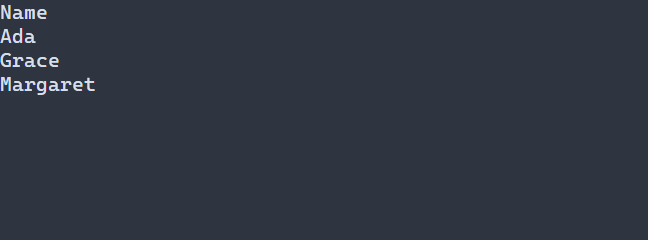
Name column with three rows in the virtual-table example
Styling reference
Declarative tables use VirtualTable; the managed virtual-view API defaults to Table unless a target was supplied. A directly bound widget uses its registered target. Body rows use normal or :selected; headings use :header independently of selection. VirtualTableOptions::normal, selected, and header provide defaults beneath the cascade. The list's match-highlight option does not style table cells.
Use foreground, background (#RRGGBB) and bold, italic, underline (true or false). A rule without a state applies to all variants. See the cascade and size constraints; min-width requires a state-independent selector.
VirtualTable:header { bold: true; background: #304050; }
Use VirtualTable<T>. The program below displays a Name header and three rows with standard keyboard and mouse navigation. Press F10 to close.
The program uses Names, an immutable ModelSnapshot<std::string> adapter with three records, and displayText, which creates GraphemeText. The adapter, helper, headers and complete program appear below and in guide_vtable.cpp.
Complete program
#include <array>
#include <portals/ui.hpp>
#include <stdexcept>
#include <utility>
using namespace portals;
public:
Names() : ModelSnapshot(1, 3) {
}
return {RangeState::READY, std::span(rows_).subspan(static_cast<std::size_t>(range.first), range.count), {}};
}
private:
const std::array<ModelRow<std::string>, 3> rows_{{{{1, 1}, "Ada"}, {{2, 1}, "Grace"}, {{3, 1}, "Margaret"}}};
};
GraphemeText displayText(std::string_view value) {
auto result = GraphemeText::from(value);
if (!result) {
throw std::runtime_error("Invalid display text");
}
return std::move(*result);
}
int main() {
using namespace portals;
// clang-format off
return [] {
auto scene = ui::scene([](ManagedScene &owner) {
const std::array<TableColumn<std::string>, 1> columns{{
{{1, 1}, displayText("Name"), 18, [](const std::string &name) {
return displayText(name);
}}
}};
return ui::virtualTable(model, columns);
});
});
return std::move(scene)
| ui::onKey("F10", ui::quit);
} | ui::runApp();
// clang-format on
}
Owning validated UTF-8 and immutable extended grapheme measurements.
Definition text.hpp:145
static std::expected< GraphemeText, TextError > from(std::string_view bytes, WidthPolicy policy={}, TextLimits limits={})
Validate, segment and measure a single logical UTF-8 buffer.
Additive lifecycle owner over one existing Application subtree. UI affine and nonmovable....
Definition managed.hpp:530
std::expected< ManagedModel< T >, ManagedError > model(std::shared_ptr< const ModelSnapshot< T > > initial, ModelOptions options={}, ManagedViewHandler< T > prepared={})
Create a scene-owned model and a weak typed UI handle.
Definition managed_views.hpp:65
Immutable list/table provider storage, independent of view/source lifetime. Implement read as bounded...
Definition model.hpp:94
@ READY
Exactly the requested immutable rows are available.
Definition model.hpp:47
Half-open logical row interval; arithmetic is checked before provider access.
Definition model.hpp:35
The standalone guide project builds target guide_vtable; run the resulting executable in a terminal. It links portals::core.
Each TableColumn owns a stable ColumnId, header, cell width and formatter. The recipe copies the column array, so it can be local to the factory. The scene handles preparation and input. Pending data requires prepared in ui::VirtualTableConfig<T>. TBD: the requested ui::vtable alias is unavailable; no delivery date is assigned.
Read the visible rows
Keep a typed table reference and obtain its deferred visible source:
auto visible = table.visibleModel();
Typed Widget observation; explicit composite specializations reuse their existing weak facades.
Definition ui_ref.hpp:761
Pass table to the reference overload of ui::virtualTable. Creating visible does not read data; the table can be mounted later. In a UI event handler after the table has been prepared, obtain one stable snapshot:
auto rows = visible.snapshot();
if (!rows) {
summary.text() = "Visible rows are not available";
return;
}
std::size_t bytes = 0;
for (const auto &name : *rows) {
bytes += name.size();
}
summary.text() = std::format("{} rows, {} UTF-8 bytes",
rows->size(), bytes);
This fragment assumes summary is a mounted ui::Ref<Label> and the model row type is std::string. Include <format> for std::format.
VisibleModelSnapshot<T> is an owning, read-only forward range of const T&. Its rows remain unchanged when the table scrolls or is removed. rows() additionally exposes each value's RowId. Copying a snapshot shares its immutable storage; it does not copy every value. Retain the snapshot while using its iterators or references.
The range contains body rows intersecting the final viewport and ancestor clip, including a partially visible row once. It excludes the header and overscan. An empty ready table yields a successful empty range. Provider waiting/failure and an unprepared view are distinct errors, not successful empty data.
Snapshot availability and lifetime
Call snapshot() on the owning UI thread, outside tree frames and managed preparation callbacks. Before mount or after scene cleanup, access is closed; removal preserves the original stale identity. A scroll/configuration change can leave the view NOT_PREPARED until its next completed preparation/layout. PENDING and FAILED describe provider readiness; failure text is owned. VisibleModelError distinguishes these states from a ManagedError for access. Checked reads return errors directly without automatic reporting.
A retained snapshot pins its provider storage, which can be larger than the visible range. Avoid accumulating snapshots without a retention policy. Already obtained snapshots stay readable after scene destruction; payload destruction follows the model's existing thread contract. This API does not copy history or add a streaming buffer.
Automatic computations and bindings over the visible source remain TBD — M4.
Terms: recipe, frame, ownership.
API reference and constraints
VirtualTable<T> presents immutable typed records through contiguous fixed-width columns and fixed-height rows. The first cell row is always the header. A model with no rows still displays its headers; an empty column set displays a blank viewport. There are no row or cell widgets, editing controls, or implicit workers.
Ownership and preparation
Create the table on the UI owner with an independent ModelConsumer<T> from Model<T>::openRange(), a span of TableColumn<T>, and VirtualTableOptions. The constructor synchronously copies the definitions, headers, and formatter captures. The span and its elements need live only until that call returns. T need not be copyable or default-constructible: a formatter borrows const T& from the immutable snapshot and returns an owning GraphemeText.
Each column has a unique nonzero ColumnId pair, positive width in cells, header text, and a copyable formatter. Identity remains independent of visual order; providers must increment the generation when reusing an identity. Headers and formatter results use the options' width policy. Formatters must not perform I/O, mutate the tree/model, keep row borrows, or allocate unbounded temporary storage. Exceptions are translated at preparation, except that termination inside a user callback cannot be recovered by the table.
Between frames, apply queued model publications, obtain one ModelFrame<T>, and pass that same pin to prepareVirtualTable and sibling views. The local viewport includes the header and must match the final arranged size exactly. The application supplies this final size from its layout constraints. Preparation must not run during WidgetTree::frame.
Preparation reads one viewport-plus-overscan range for all columns. Only ready rows intersecting the body viewport and columns intersecting its width are formatted. Overscan rows are requested but never formatted. The table stages owning cell text, header text, stable IDs, and a copy of the pin together. A formatter or allocation failure preserves the previous successful presentation. A successful unchanged preparation does not invalidate or schedule another frame. Updates outside the viewport may reprepare the bounded window; they never scan the logical row count or locate IDs globally.
The table reuses VirtualList's checked window arithmetic and ancestor visibility inspection. Its column clipping and header input geometry remain local to the table; the range-request and navigation protocol follows VirtualList without a new shared widget framework. See the model contract and VirtualList preparation.
A provider completion may contain a bounded prefetched page around the requested interval. During later preparation the view can read the new exact window from its retained completion snapshot when both data revision and row count match the current pin. It retains one such owner, formats only current visible rows, and respects the model's read budget. A cache miss remains pending and schedules the new exact request; provider failures are not replaced by older ready data. A revision change or hidden view releases the old prepared owner. Public base reads and independent consumer results retain their existing exact semantics.
Rendering, requests, and selection
measure, arrange, and paint do no provider reads, formatting, mutation, loading, or terminal I/O. Paint emits widget-local commands. The application translates them through current node geometry and ancestor clipping, then renders borrowed command text before the enclosing tree.frame returns. Each header and cell has its own half-open clip; a wide grapheme never spills into the next column. The last fixed-height row may be partially clipped. The body and header backgrounds cover unused cells deterministically.
Pending cells show ...; failed cells show !. Preparation returns each new ModelRequest<T> once for caller dispatch and never starts a worker. Keep the receipt until completion, or cancel it if dispatch fails. retryVirtualTable requests a fresh receipt on the next preparation. Cancelled receipts still occupy the model's in-flight budget until their owners release them. Hidden ancestors and destruction cancel requests without joining workers; hidden preparation releases the prepared range and text while retaining the selected stable ID.
bindVirtualTable uses the existing router for arrows, Home/End, left press, and integral wheel movement. Keep the returned scoped ActionBinding; the tree/router outlive it. A header click does not select a row. Body clicks account for surface origin, clipping, header height, and fixed row height. Selection uses RowId, spans the whole body row, and survives offscreen movement or reordering. Removed IDs remain selected until explicitly cleared. Navigation searches only the prepared visible IDs; pending positional intent is scoped to its data revision.
Mutation, budgets, and errors
Use the tree-checked free functions on the owner thread:
- setVirtualTableFirst sets an integral first row, cancels old work/intent, and invalidates paint; preparation clamps it to the model bounds.
- setVirtualTableSelection changes a stable ID and invalidates paint only.
- setVirtualTableColumns synchronously validates and copies a borrowed span. On validation, allocation, or capture-copy failure, the old configuration and presentation remain unchanged. On success, replacement invalidates layout and requires preparation before paint. The span is never retained.
- setVirtualTableOptions validates settings and existing header compatibility, invalidates layout, and requires preparation. To change the width policy, clear columns, set the new policy, then install rebuilt headers between frames.
Defaults bound configured columns to 64, visible body cells to 16384, and the sum of all configured header UTF-8 bytes plus visible cell UTF-8 bytes to 1 MiB. These are configurable positive limits, checked without silent truncation. The existing model range limit independently bounds requested rows, including overscan. The cell product is checked by division before multiplication could overflow. Header validation is bounded by configured columns; no work scales with logical row count. These bounds cover retained table data, not arbitrary temporary allocations inside an application formatter.
Invalid dimensions, IDs, widths, policies, and exceeded budgets report TreeError::INVALID_ARGUMENT; allocation failure reports NO_MEMORY, and other formatter/capture-copy exceptions report CALLBACK_FAILED. Tree affinity, lifetime, frame, and model-session errors stay explicit. Paint reports WOULD_BLOCK for unprepared/dirty data and INVALID_GEOMETRY for a viewport mismatch. Discard partial render commands on any paint/sink error. A setter can make the old presentation dirty; a later failed preparation does not clear that requirement.