Loading...
Searching...
No Matches
Bind model values to captions
Русская версия · Collection views · Bindings and events
Use a value model when several controls should display or change one accepted value. A value may be a number, a boolean, an enum, an owning string or a record. Labels, button captions and ordinary frame titles use the same model declarations, field projections and formatted expressions. The scene registers and observes the values when the receiving recipes mount.
Choose a source and change its value
This complete program keeps separate populations for Europe and Asia. Choosing a button changes the source of the summary. +1 million changes the population of the displayed source; switching back shows that source's accepted value.
// Copyright (c) 2026 ttldtor.
// SPDX-License-Identifier: BSL-1.0
#include <portals/ui.hpp>
#include <portals/ui_style.hpp>
#include <format>
#include <string>
#include <utility>
using namespace portals;
struct Region {
std::string name;
int population;
bool operator==(const Region &) const = default;
};
int main() {
auto europe = ui::model(Region{"Europe", 742});
auto asia = ui::model(Region{"Asia", 4800});
auto selected = europe;
ui::Ref<Label> summary;
return std::format("{}: {} million people", region.name, region.population);
};
auto choose = [&](ui::Model<Region> candidate) {
if (summary.model(candidate)) {
selected = std::move(candidate);
}
};
auto increase = [&] {
selected.field(&Region::population) += 1;
};
// clang-format off
return ui::scene(ui::vbox(LinearOptions{.gap = 1},
ui::label(summary, europe, describe),
ui::hbox(LinearOptions{.gap = 2},
ui::button("Europe", [&] { choose(europe); }),
ui::button("Asia", [&] { choose(asia); }),
ui::button("+1 million", increase)),
ui::label("Each source keeps its own value. Tab selects a button; Enter activates it."))
.maxWidth(76).fitHeight().framed("rounded", "Region populations"))
| ui::theme(nordTheme())
| ui::onKey("F4", increase)
| ui::onKey("F10 | Ctrl+C", ui::quit)
| ui::runApp();
// clang-format on
}
Owning cold model declaration; copies share one single-scene registration. Construction does not read...
Definition ui_model.hpp:129
Typed Widget observation; explicit composite specializations reuse their existing weak facades.
Definition ui_ref.hpp:761
bool model(const LogSource &source, std::source_location origin=std::source_location::current()) const
Definition ui_ref.hpp:1089
auto describe(const StaticScene< Root > &value, Adapters... adapters)
Definition ui_static.hpp:605
StyleSheet nordTheme()
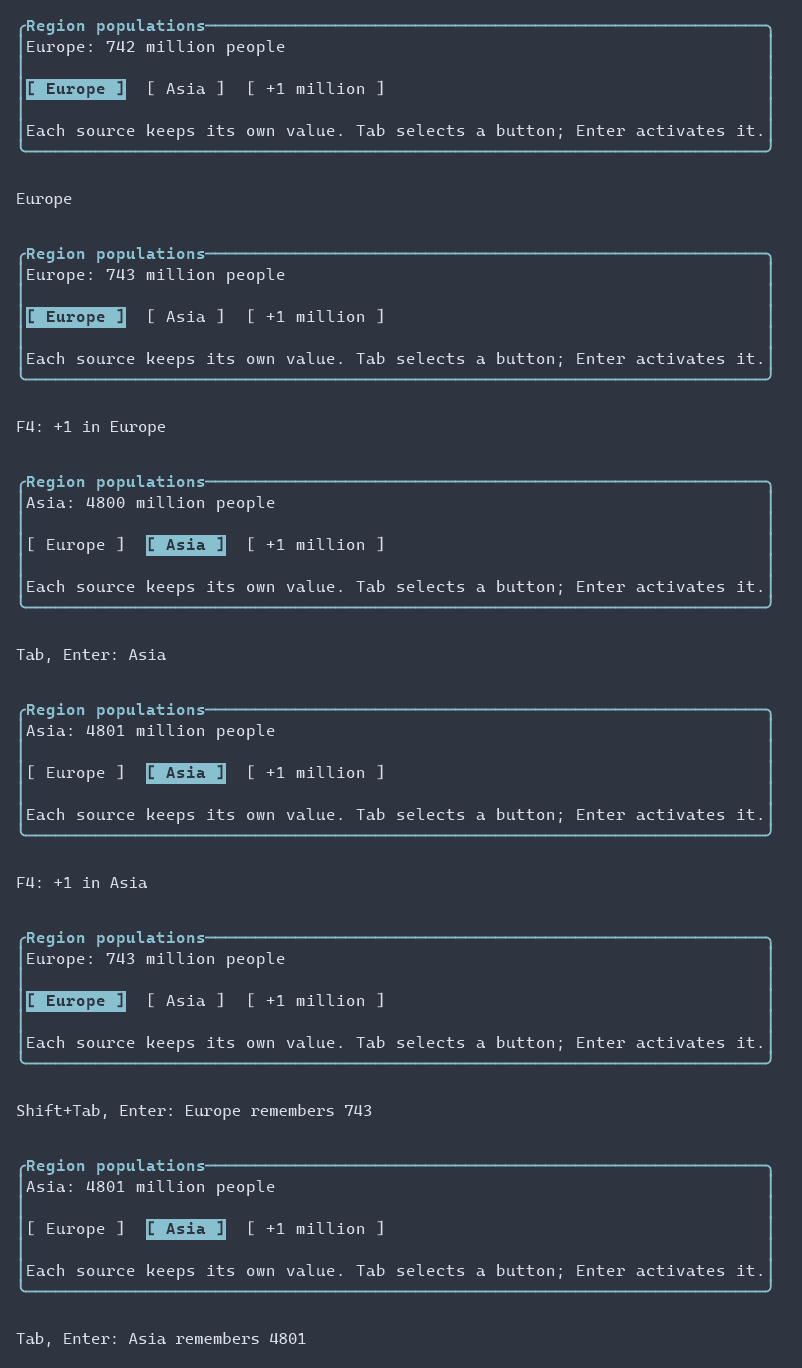
Switching sources retains each region's population
The animation shows F4 changing the active population, then keyboard selection switching between sources. It uses captured application terminal cells with input steps displayed below the frame; it is not a recording of a particular terminal host.
The describe projection belongs to the label binding. summary.model(candidate) checks the replacement and keeps that projection. The selected descriptor changes only after successful admission, so a rejected replacement leaves both the displayed source and the next write target unchanged. There is no separately updated region name or formatted-string state.
Build the program with the consumer application setup, linking portals::core. The complete source is available as guide_value_models.cpp.
Update a value or replace a source
The following UI-handler fragments assume that the models and references from the complete example have mounted successfully:
europe.value() = Region{"Europe", 743};
europe.field(&Region::population) += 1;
summary.model(asia);
value() and field() address the accepted value of one model. Field assignment copies the latest record, changes the requested member and publishes through the same root property, preserving the other members. Addition uses that member's ordinary C++ addition semantics; it does not add saturation or overflow checking.
Copying or assigning ui::Model<T> descriptors shares their declaration. It does not copy or publish the current value. A descriptor owns its declaration and initial value; a mounted handle observes a scene-owned property and does not keep the scene alive. Registration and value access belong to the creating UI thread. A declaration is single-scene; create a new one for another scene.
Checked reads and writes do not report errors automatically:
auto snapshot = europe.value().snapshot();
auto update = europe.field(&Region::population).set(744);
auto replacement = summary.setModel(asia);
std::expected< void, ManagedError > setModel(const LogSource &source, std::source_location origin=std::source_location::current()) const
Definition ui_ref.hpp:1079
Check these results before reading their payloads. A successful PropertyUpdate retains the accepted root snapshot, change flag and notification receipt. Rejected delivery after a commit does not undo the accepted value. Short assignment, += and .model(...) use the existing scene error collector; a failed setup stage stops subsequent setup and application startup after the current callback finishes.
One value, three receiving controls
This complete program binds a label, a button caption and a frame title to the same counter. Pressing the button updates all three. The title is clipped to the current frame width and grows visible again when the terminal becomes wider.
// Copyright (c) 2026 ttldtor.
// SPDX-License-Identifier: BSL-1.0
#include <portals/ui.hpp>
#include <portals/ui_style.hpp>
using namespace portals;
struct Counter {
int clicks{};
bool operator==(const Counter &) const = default;
};
int main() {
auto counter = ui::model(Counter{});
auto clicks = counter.field(&Counter::clicks);
ui::Ref<Button> increment;
// clang-format off
return ui::scene(ui::vbox(
ui::label(clicks),
ui::button(increment, text("Increment ({})", clicks)))
| ui::onClick(increment, [clicks]() mutable { clicks += 1; })
| ui::theme(nordTheme())
| ui::onKey("F10 | Ctrl+C", ui::quit)
| ui::runApp();
// clang-format on
}
ui::ValueText text(std::format_string< const ui::detail::TextArgumentValue< Args > &... > pattern, Args &&...args)
Declare live formatted text over explicit scalar roots, fields or value properties.
Definition ui_value_text.hpp:567
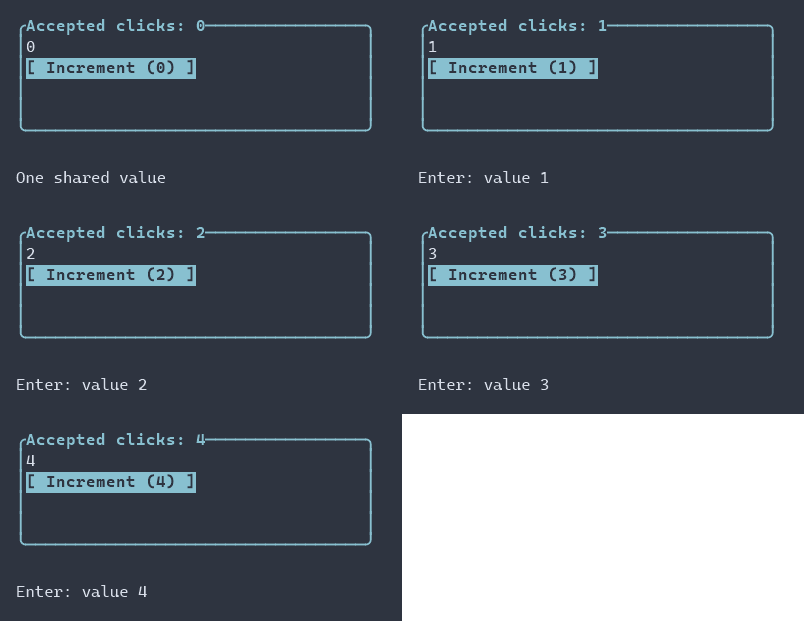
One accepted value updates the label, button caption and frame title
Formatted text owns its arguments and observes their explicit model dependencies:
ui::label(text("Population: {}", europe.field(&Region::population)))
The standard format string is checked against the underlying field value type. Static string views and character arrays are copied into the expression. No temporary snapshot or member reference is retained. Repeated fields of one root use one observation per receiving expression. Equal output does not change the caption or request another redraw. Hidden recipients have no timer or continuous polling.
A projected caption such as ui::label(summary, europe, &Region::name) preserves its projection when .model(asia) accepts a compatible root. A formatted caption such as ui::label(summary, text("{}", europe.field(&Region::name))) has a complete computed text source. Replace that source with another text(...) expression; passing one of its input models is rejected rather than silently redirecting a hidden dependency.
Ordinary .framed("rounded", expression) recipes create a passive Border title. The overload with an observing frame reference supports outer.setModel(...) and outer.model(...). Frame patterns, decorations, size policies and allocated geometry survive title changes. Invalid or oversized titles preserve the previous valid title. The native frames inside ScrollArea, LogView and DocumentView retain their static title API; these live-title overloads are unavailable for those recipes.
Localize a live format string
Pass an owning TextValue and the existing resource resolver protocol. A resolver may take only the resource key, or the key followed by the underlying argument values. Use the second form when resolution depends on an explicit language model:
auto population = ui::model(742);
auto russian = ui::model(false);
auto resolve = [](std::string_view key, int, bool ru)
-> std::expected<std::string, TextResourceError> {
if (key != "population") {
return std::unexpected(TextResourceError::MISSING_RESOURCE);
}
return ru ? "Население: {0}" : "Population: {0}";
};
@ MISSING_RESOURCE
The caller's resolver could not find the requested resource key.
Definition text_resource.hpp:10
constexpr TextValue i18n(std::string_view key)
Copy a resource key for later resolution through an explicit caller.
Definition text_value.hpp:227
The population occupies format argument zero. The language is argument one and an explicit dependency even though the translated pattern does not print it. Changing either model triggers resolution; an unchanged frame does not. The resolver receives the retained input snapshots directly, including during initial mount. It should not read unpublished models or change UI state. Resource access must be short and memory-only on the UI thread. The expression retains the resolver's captures. Any borrowed services captured by the resolver must remain valid for the lifetime of the mounted binding.
Translated format strings are checked at runtime. A missing initial resolver retains RESOLVER_REQUIRED in ManagedError::resource; initial resource lookup errors retain their resource category. Later resolution failures use the existing observer's TreeError channel and preserve the last valid caption. That channel does not retain the separate TextResourceError category. Invalid formatting also preserves the last valid caption and reports through the existing observer error policy.
Follow the accepted source of shared navigation
Use navigation.current() when a caption should follow the source accepted by a shared list/table group. bySource maps that resource to owning domain metadata:
ui::label(region, navigation.current(),
ui::bySource<City>({{europe, "Europe"}, {asia, "Asia"}}))
The complete model-switching example uses this binding. Rejected group admission keeps the old source and caption. Successful admission publishes the accepted resource before dependent observation. Delivery rejection after admission leaves that accepted source installed.
The default metadata type is std::string. ui::bySource<City, Region>(...) can instead return an owning record, and other copyable owning types are supported. The catalog copies metadata and descriptors, without registering unselected cold models or acquiring additional row ranges or snapshots. Captured model declarations retain their normal initial-value and provider ownership. Lookup scans catalog entries, not model rows. CollectionLimits::maxRows bounds the number of entries, defaulting to
- Unknown resources, duplicate matches, invalid descriptors, retired sources, foreign threads and mixed registered scenes produce typed failures; the adapter does not guess a different source's metadata.
Data capabilities and cost
ui::model("text") and ui::model(std::string(...)) declare scalar strings. ui::model(std::array{...}) declares the existing bounded owning sequence; an immutable ModelSnapshot<T> remains a provider with its own range access. Arbitrary input or infinite ranges are not implicitly materialized. Convert a borrowed string view to an owning string explicitly before storing it as a model value.
Whole-value and field updates use the existing owning Property<T> contract: copying, equality, projection and formatting must be bounded, pure and non-reentrant. Large data belongs in the provider and window-source APIs, with its work off the UI thread. A value model does not turn a large file into a copied scalar or an unknown-length source into a finite sequence. Tree bookmarks use the common position protocol; these bindings do not add a TreeView or flatten a hierarchy.
This API provides accepted owned values and read-only projections. External conditional writes, editable current-record forms and draft history have separate contracts. Existing ManagedState<T> and ManagedSource<T> can be wrapped with ui::model(state) and ui::model(source). A read-only alias keeps its original readiness, thread and lifetime checks and rejects writes; it does not acquire write authority by being wrapped.