Loading...
Searching...
No Matches
Switch a model and remember your place
Русская версия · Shared navigation
This guide covers managed finite-model lists and tables. LogView uses its own bookmark-capable source integration, including sources without a total row count.
Declare a model and its views
Use ui::model to describe an owning small sequence or an existing immutable provider. Registration occurs when a view mounts. With the City type from the complete example:
auto europe = ui::model(std::array{City{"Prague", 3}, City{"Vienna", 6}});
auto navigation = ui::navigation(europe, {.readingAnchor = true});
auto views = ui::hbox(
ui::virtualList(navigation, &City::name),
ui::virtualTable(navigation,
tableColumn("City", &City::name, 18),
tableColumn("Orders", &City::orders, 8)));
TableColumn< T > tableColumn(TableColumnOptions options, Projection projection, Formatter formatter)
Compose an owning typed column from explicit projection and text formatting.
Definition table_column.hpp:84
A list projection can be a member pointer or a lambda. Standard-formattable scalar rows need no projection: ui::virtualList(model). Columns accept member/lambda projections with default formatting or an explicit formatter. Schema errors retain their typed cause during mount.
Copies of a ui::Model<T> share one registration in one scene. Passing that Model to several views gives each independent navigation. Passing an explicit ui::Navigation<T> shares its enabled channels; separate ui::navigation(model) calls create separate sessions. These descriptions use the existing managed models, properties and preparation loop. They do not add another runtime or application-owned history map.
Switch models
A mounted list or table remembers its current row, selected identities and reading anchor for each model it has visited. Switching A → B → A restores A by stable row identity; it does not copy an ordinal from B. Different views remember their own positions unless they are explicitly bound to the same navigation context.
// Independent views: each keeps its own position for each model.
list.model(europe);
table.model(europe);
// Shared navigation: change all participants together.
navigation.model(europe);
// Explicitly discard the target checkpoint and use its initial position.
list.model(europe, {.restore = ModelRestorePolicy::RESET});
The collected model(...) forms send errors to the scene's existing diagnostics. Use setModel(...) when the caller needs an immediate checked result. These operations run on the UI thread; provider payload work stays on the existing preparation path. A shared-context change admits all participant consumers and metadata before replacing any binding. Admission failure keeps the old group installed. Independent calls do not form a transaction merely because they appear next to each other. Automatic group rebinding does not construct an adapter for an arbitrary cross-model projection; such participants are rejected before any binding is replaced.
What counts as the same place
A finite provider implements bounded locateRow(RowId) when direct navigation needs an identity index. Its default is UNSUPPORTED; the UI does not scan the model to guess an ordinal. The small owned sequence supplies this index; custom providers implement it as described in model bookmarks.
An existing row stays current across insertion and reordering. A declared removal may choose a surviving neighbor when the provider supplies the required ordering proof. Filtering a row out is not evidence that it was deleted. A selected non-current row that is proven deleted is removed from the selected set, not replaced with its neighbor. Current, selected set and reading position remain separate logical values.
An unresolved return retains its checkpoint and suppresses an incorrect initial row-zero frame. Pending resolution follows model publication and existing request delivery; paint and resize do not poll the provider. restoreStatus() reports the identity outcome. Unsupported, incompatible or unavailable history is a view-local failure; it does not mark an otherwise healthy model or an independent sibling as failed. A newer publication may supply the missing proof. Use explicit RESET to abandon that saved position.
Resource and lifetime boundaries
Automatic identity belongs to the registered model. Reopening a provider as another registration requires the explicit ModelResource/source-session contract to attest continuity. Equal values, equal row numbers or coincidentally equal ids are insufficient. A different history lineage is incompatible. Explicitly attested checkpoints can survive switching away and retiring the old provider; no model, row page or provider is retained by the checkpoint. Retiring the currently active model still closes its navigation context. This API does not yet change that lifecycle or provide disk persistence.
Preparation and errors
Ordinary preparation belongs to the model. Switching models uses the destination's loader; an arbitrary callback capturing the old provider is never silently reused. Low-level override retention, replacement and clearing are explicit options. Changing only that callback on the same model does not reopen a consumer, reset navigation or cancel an outstanding resolution request.
Default history metadata is bounded to 256 KiB per view session or shared context; bookmarks default to 4096 bytes and selected sets to 1024 ids. Limits do not depend on row count. Exhausting admission returns a typed error without silently evicting another model's position. Old and new staged metadata count against the budget together.
After a successful shared-context installation, all current channel snapshots and view bindings describe the installed group before observer delivery begins. Historical queued payloads keep their own qualified resource and outcome. Delivery rejection is a reported postcommit error and does not roll back installed state. An unsuccessful admission may leave a harmless layout invalidation request; it does not install part of the new group.
Edit a small owned sequence
ui::model(std::array{...}) owns copyable values and assigns stable row identities. Equal values remain distinct rows. After mount, its checked UI-thread operations return std::expected<void, ManagedError>:
| Operation | Effect |
|---|---|
| model.insert(index, value) | Insert one copied value with a fresh identity. |
| model.erase(first, count) | Remove a range; count defaults to 1. |
| model.move(first, count, destination) | Preserve identities; destination is the index after removing the range. |
| model.clear() | Remove all rows. |
| model.update(id, value) | Replace one owned row value while preserving its identity and order. |
Handle the result before updating dependent application state. Allocation/admission failure preserves the installed snapshot. Empty erases, an unchanged move and clearing an empty sequence do not publish a revision. Erased identities are never reused, and successful structural changes advance a positive revision. Owning a value preserves its normal C++ semantics: a string_view or reference inside it still borrows its target.
The default capacity is 4096 rows, configurable with CollectionLimits. The adapter retains the latest 1024 structural changes by default, configurable with PositionMapOptions. Further edits keep working. A still-present identity resolves EXACT even after its old revision leaves that proof window. For a missing identity older than the retained proof, restoration reports UNAVAILABLE and keeps the checkpoint; it does not guess a neighbor. Within the window a proven deletion can resolve NEAREST. This proof retention is separate from the view/context checkpoint budget above. Provider models do not acquire these owning mutations; their checked mutation calls return INVALID_ARGUMENT.
Update a row and keep your place
Use model.update(id, value) for a checked replacement of an existing owned row. Obtain the complete RowId from that model or its navigation; it is local to the source, not a row number or a globally unique key. An unknown, erased or wrong-generation identity reports a typed error. The operation never writes to a neighbor when its target is missing.
navigation.currentRow() reads the existing current channel as expected<optional<RowId>, ManagedError>. An empty current is a successful nullopt; a cold, closed or wrong-thread handle retains its checked error. It does not register a binding or load a row. Keep the navigation and mutation source matched. A RowId does not encode its source: equal value/generation pairs can be accepted by another model, and update cannot detect that mix-up. Use the key with the model currently associated with the navigation.
A successful replacement keeps the row's identity, ordinal and the shared current, selection and reading anchor. Earlier snapshots retain their original value. For equality-comparable rows, replacing a value with an equal value is a no-op. Other copyable rows can publish a revision on each explicit replacement. A value-only revision does not consume the retained structural-change history.
The short model.row(id, value) form performs the same update and reports failures through the scene's existing diagnostics. It returns true on success. Use the checked form when an event handler can return the result directly, or when later application state depends on acceptance:
// Inside a UI handler, with an identity obtained from this model:
stops.row(id, Stop{"Prague", 2});
// An expected-returning handler can return the original checked result:
return stops.update(id, Stop{"Vienna", 3});
Allocation, copy, validation or admission failure before commit preserves the installed snapshot. A delivery error after acceptance does not undo the accepted value. Provider-backed models keep their own write capabilities; this operation neither loads their rows nor gives a read-only source permission to write.
This API edits a small owned sequence. Staging a new immutable snapshot copies its rows and rebuilds its index; it is not a constant-time write into an arbitrarily large data source. Use the provider path below for externally stored or unbounded models. Conditional external writes and edit sessions are separate capabilities.
Complete itinerary example
Choose a stop in either view, then press F2/F3 or use the destination buttons. Both views update the same row and retain their current position. Tab changes focus; F10 or Ctrl+C exits. A stop remains the same itinerary entry even when its destination changes.
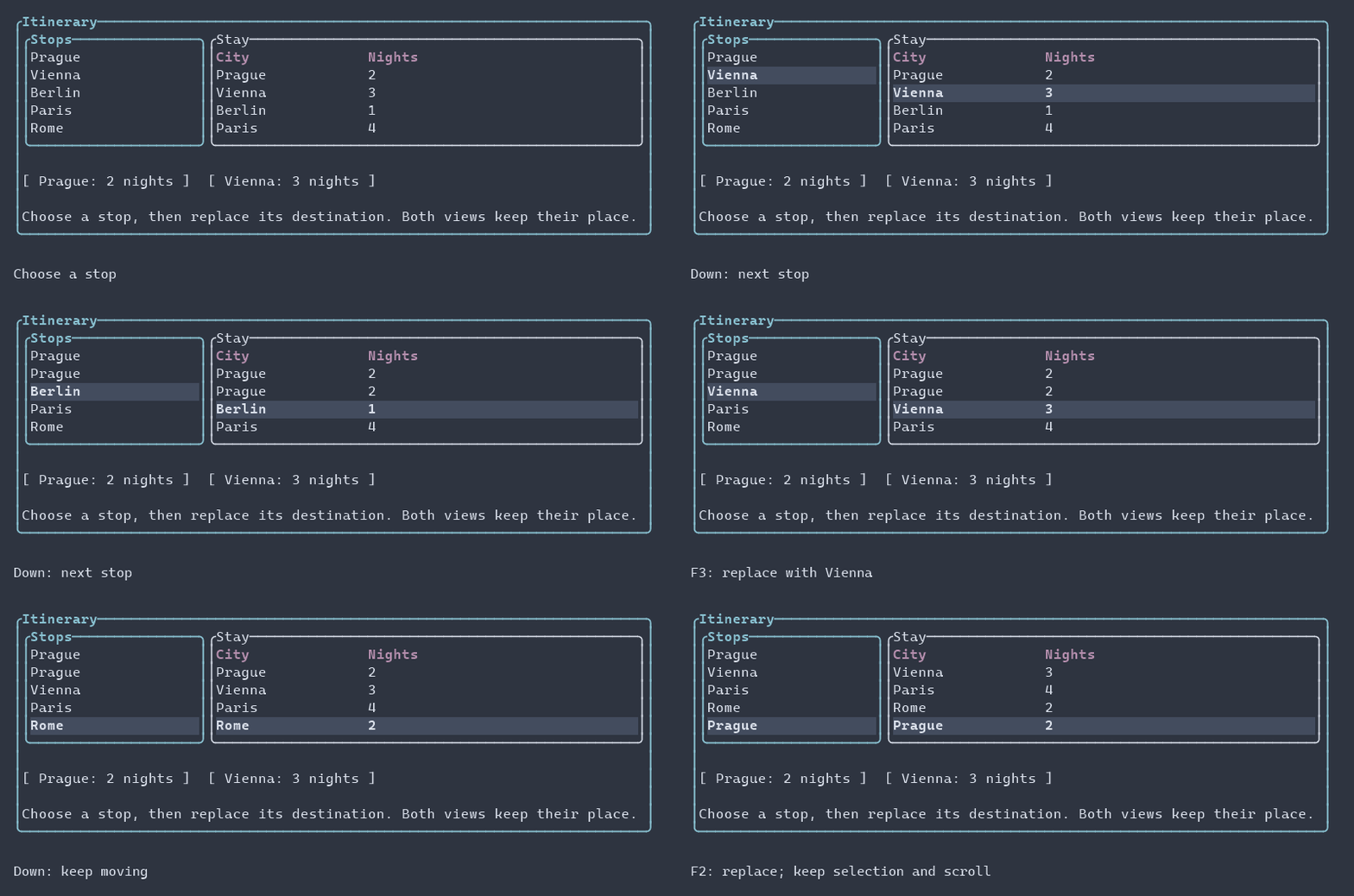
Replace an itinerary stop while both views retain their place
// Copyright (c) 2026 ttldtor.
// SPDX-License-Identifier: BSL-1.0
#include <portals/table_column.hpp>
#include <portals/ui.hpp>
#include <portals/ui_style.hpp>
#include <array>
#include <expected>
#include <string>
using namespace portals;
struct Stop {
std::string city;
int nights;
bool operator==(const Stop &) const = default;
};
int main() {
auto stops = ui::model(std::array{Stop{"Prague", 2}, Stop{"Vienna", 3}, Stop{"Berlin", 1},
Stop{"Paris", 4}, Stop{"Rome", 2}, Stop{"Oslo", 1}});
auto navigation = ui::navigation(stops, {.readingAnchor = true});
auto replace = [&](const Stop &stop) -> std::expected<void, ManagedError> {
auto current = navigation.currentRow();
if (!current) {
return std::unexpected(current.error());
}
return *current ? stops.update(**current, stop) : std::expected<void, ManagedError>{};
};
// clang-format off
return ui::scene(ui::vbox(LinearOptions{.gap = 1},
ui::hbox(
ui::virtualList(navigation, &Stop::city).width(22).framed("rounded", "Stops"),
ui::virtualTable(navigation,
tableColumn("City", &Stop::city, 18),
tableColumn("Nights", &Stop::nights, 8))
.framed("rounded", "Stay"))
.height(7),
ui::hbox(LinearOptions{.gap = 2},
ui::button("Prague: 2 nights", [&] { return replace(Stop{"Prague", 2}); }),
ui::button("Vienna: 3 nights", [&] { return replace(Stop{"Vienna", 3}); })),
ui::label("Choose a stop, then replace its destination. Both views keep their place."))
.maxWidth(76).fitHeight().framed("rounded", "Itinerary"))
| ui::theme(nordTheme())
| ui::onKey("F2", [&] { return replace(Stop{"Prague", 2}); })
| ui::onKey("F3", [&] { return replace(Stop{"Vienna", 3}); })
| ui::onKey("F10 | Ctrl+C", ui::quit)
| ui::runApp();
// clang-format on
}
StyleSheet nordTheme()
Keep the provider path for large data
For an existing std::shared_ptr<const ModelSnapshot<T>>, use ui::model<T>(provider). Declaring or mounting it neither reads nor copies row payloads; rows may be noncopyable. Visible-range preparation and publication retain the existing provider ownership. See immutable models for snapshot, publisher and worker integration.
Existing column arrays and named configs also work with a cold Model:
// model, columns, config and tableRef have matching row types.
auto view = ui::virtualTable(tableRef, model, columns, config);
columns may be a TableColumn<T> array/span; the recipe owns its copied definitions and config. An empty config.prepared uses the model's preparation handler; a nonempty handler overrides it for this view. This form keeps independent navigation and accepts ui::Model<T>, with no automatic shared-coordinate assertion for arbitrary projections. The existing ManagedModel<T> factories remain available for advanced integration.
Use model.managed() after successful mount when an existing publisher or low-level API needs the checked runtime handle. Publisher admission, producer shutdown and borrowed capture lifetimes remain application obligations. Descriptors are single-scene: empty, failed, foreign-scene and closed handles produce typed errors. For a valid descriptor, managed() is CLOSED before publication and after scene closure. Mount failures follow the existing scene/ runApp diagnostic path; setModel and sequence edits expose immediate checked errors.
Providers may optionally override ModelSnapshot::positionHistory() to return a bounded, qualified change proof. Its default requires no override or per-source history storage. This addition is source-compatible, but changes the virtual interface: rebuild provider binaries and SDK consumers against matching installed headers and library. Compatibility with an older binary SDK/provider vtable is not promised.
Unversioned finite models
Revision zero remains a valid ordinary finite model. It lacks the positive revision needed by a bookmark, so returning to its saved position reports UNSUPPORTED. Mounting, local keyboard navigation, switching away and explicit RESET remain usable. RESET uses the ordinary initial state and clears the incompatible restore intent. A later positive publication does not retroactively qualify an unversioned checkpoint. Direct shared capture/navigation requiring unavailable versioned proof returns WOULD_BLOCK; native controls keep their local behavior without promising shared bookmark continuity.
Complete shared-group example
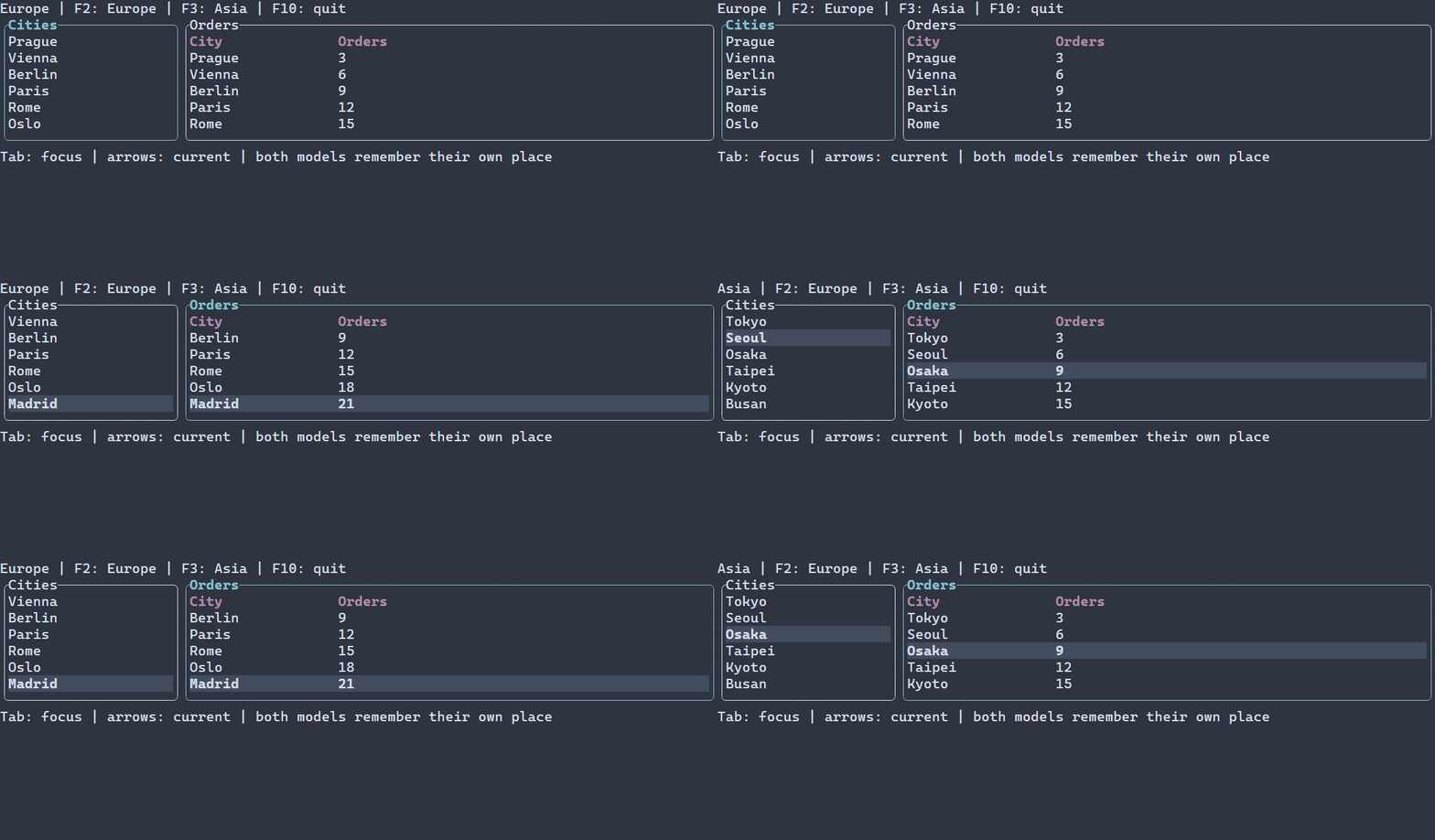
Two views switch model together and remember each model's position
Full source declares two small owned models with ui::model and binds a projected list and table through ui::navigation. Move with arrows, switch regions with F2/F3, and return to the former region. Both views recover that region's logical place. Tab changes focus; F10 or Ctrl+C exits. The caption observes the accepted navigation resource through navigation.current() and the owning ui::bySource projection. Failed group admission keeps the old caption; there is no separately assigned region-name state. Metadata may also be an owning record or enum; see value models.
The views share the current row and remember their positions for each model. Each view reveals the current row within its own body: a table header reduces visible data rows, so the first visible rows may differ. With readingAnchor enabled, explicit scrolling also shares a logical reading anchor; automatic scrolling to reveal the current row does not lock the viewports together. A late shared-position update is consumed by earlier views on the next ordinary frame, without another input. Build portals_docs_view_models with tests enabled, or use the installed SDK.
The complete client uses cold declarations and ordinary collected model switching; registration and group admission stay inside the SDK. Its owned arrays are the small-data path. Large provider data continues to use the linked immutable-model integration.
// Copyright (c) 2026 ttldtor.
// SPDX-License-Identifier: BSL-1.0
#include <portals/table_column.hpp>
#include <portals/ui.hpp>
#include <array>
#include <string_view>
using namespace portals;
struct City {
std::string_view name;
int orders;
};
int main() {
auto europe = ui::model(std::array{City{"Prague", 3}, City{"Vienna", 6}, City{"Berlin", 9}, City{"Paris", 12},
City{"Rome", 15}, City{"Oslo", 18}, City{"Madrid", 21}, City{"Lisbon", 24},
City{"Warsaw", 27}, City{"Riga", 30}, City{"Tallinn", 33}, City{"Helsinki", 36}});
auto asia = ui::model(std::array{City{"Tokyo", 3}, City{"Seoul", 6}, City{"Osaka", 9}, City{"Taipei", 12},
City{"Kyoto", 15}, City{"Busan", 18}, City{"Nagoya", 21}, City{"Kobe", 24},
City{"Sendai", 27}, City{"Nara", 30}, City{"Fukuoka", 33}, City{"Sapporo", 36}});
auto navigation = ui::navigation(europe, {.readingAnchor = true});
ui::Ref<Label> region;
// clang-format off
return ui::scene(ui::vbox(
ui::label(region, navigation.current(), ui::bySource<City>({{europe, "Europe"}, {asia, "Asia"}})),
ui::hbox(
ui::virtualList(navigation, &City::name).width(22).framed("rounded", "Cities"),
ui::virtualTable(navigation,
tableColumn("City", &City::name, 18),
tableColumn("Orders", &City::orders, 8))
.framed("rounded", "Orders"))
.height(8),
ui::label("F2: Europe | F3: Asia | F10: quit | both models remember their own place")))
| ui::theme(nordTheme())
navigation.model(europeSelected ? europe : asia);
})
| ui::onKey("F10 | Ctrl+C", ui::quit)
| ui::runApp();
// clang-format on
}
Typed Widget observation; explicit composite specializations reuse their existing weak facades.
Definition ui_ref.hpp:761
Owning key value without an inferred physical keyboard scan code.
Definition input.hpp:213