Loading...
Searching...
No Matches
Prepare virtual views from layout
Virtual tables, lists and charts can use their arranged sizes without duplicating layout arithmetic in application code. Choose either the managed factories in portals/managed.hpp or the explicit hooks in portals/virtual_preparation.hpp. The existing explicit CellSize preparation overloads remain available.
This is an experimental extension of the application runner. Both paths use the same tree, scheduler, model and renderer. Managed factories own registration and model pins; provider scheduling and retries remain application policy. The dashboard uses the managed path while retaining its bounded provider.
Managed models and views
Create one model with scene.model<T>(initialSnapshot, modelOptions), then pass its ManagedModel<T> handle to scene.virtualList<T>, scene.virtualTable<T> or scene.chart<T>. Each factory opens a separate range consumer, mounts the widget, and registers layout-driven preparation and its standard List, Table or Chart style identity. Lists and tables also receive their existing input bindings; charts add no input binding. The returned node, such as Node<VirtualTable<T>>, is an observer, just as with emplace. No binding token, model pin or per-view size is retained by ordinary consumer code. Explicit initial focus and theme selection remain application choices.
ManagedModel<T> is a weak, UI-affine handle. Its publisher() operation must run on the creating UI thread and returns the existing worker-safe Publisher<ModelSnapshot<T>>. Copy that endpoint on UI before using it from a worker; do not call the weak handle from the worker. The scene owns the model until close(), and a view factory rejects a model from another scene with INVALID_ARGUMENT. ManagedOptions::maxModels is a positive model-owner budget, default 64; exceeding it reports NODE_LIMIT in the STATE phase.
For each dirty, submittable frame, ManagedScene::prepare synchronizes ordinary controls, pins each owned model once, and flushes pending styles. All registered views and all layout retries share those pins. prepareViews visits views in registration order. For a chart it first evaluates the optional ManagedChartOrigin callback; an empty origin callback means row zero. After successful view preparation, it invokes that view's optional ManagedViewHandler<T>, including on layout retries and when there is no new request. A handler therefore must tolerate repeated invocation and should invalidate only when its retained presentation changes. There is no new polling loop or scheduler.
The handler receives a borrowed const ModelFrame<T>& and a borrowed const std::optional<ModelRequest<T>>&. They are valid for that invocation. Copy a present request into provider-owned storage before returning if work continues later; keep its existing typed completion and cancellation protocol. Do not retain references to either argument, dispatch the scheduler, repin models, or mutate the managed registry in this callback. Checked low-level presentation updates are allowed. Provider publication and completion can still return WOULD_BLOCK: retain the unaccepted value or completion and retry through the provider's existing service path. The managed layer does not retry it for you.
A handler may be omitted when the snapshot always supplies the requested data, as in the complete example below. If preparation instead yields a pending request without a handler, the scene cancels that request and reports PREPARE / INVALID_ARGUMENT; it cannot silently leave provider work unowned. Callback errors preserve their original TreeError and view identity through ManagedScene::run. Allocation exceptions become NO_MEMORY, and other thrown exceptions become CALLBACK_FAILED.
Hiding a view or an ancestor still prepares zero geometry to cancel range work and release prepared rows. Disabling suppresses input but keeps preparation and rendering. Removing a view retires its range consumer; late completions cannot revive it. Use scene.remove outside preparation to retire managed registrations as well. An admitted input callback may remove its own node and finishes with its captures alive. If low-level code removes a node during preparation, retired entries are pruned at the next ordinary preparation or at close; a later sibling whose identity is already stale is skipped. An admitted handler's returned error is still reported even if it removed its node.
Destroy the scene before its Application, on UI and outside callbacks or tree frames. close() removes its subtree, retires callbacks and destroys owned models; weak model handles then return CLOSED on UI, and copied publishers cannot publish to the closed endpoint. A failed factory removes only its new child and closes its range consumer; earlier successful children and the model remain scene-owned. Constructor/provider side effects are not rolled back. The existing managed control rules also apply.
Explicit hooks: one frame, two preparation phases
For a custom ApplicationScene, opt into usesPreparedLayout() and implement the existing two hooks. prepare(application, terminalSize) runs once for a dirty, submittable frame. Synchronize ordinary controls here and retain one pin per model in the scene. Then prepareViews(application, layout) prepares every sibling from that pin and the supplied owning LayoutSnapshot:
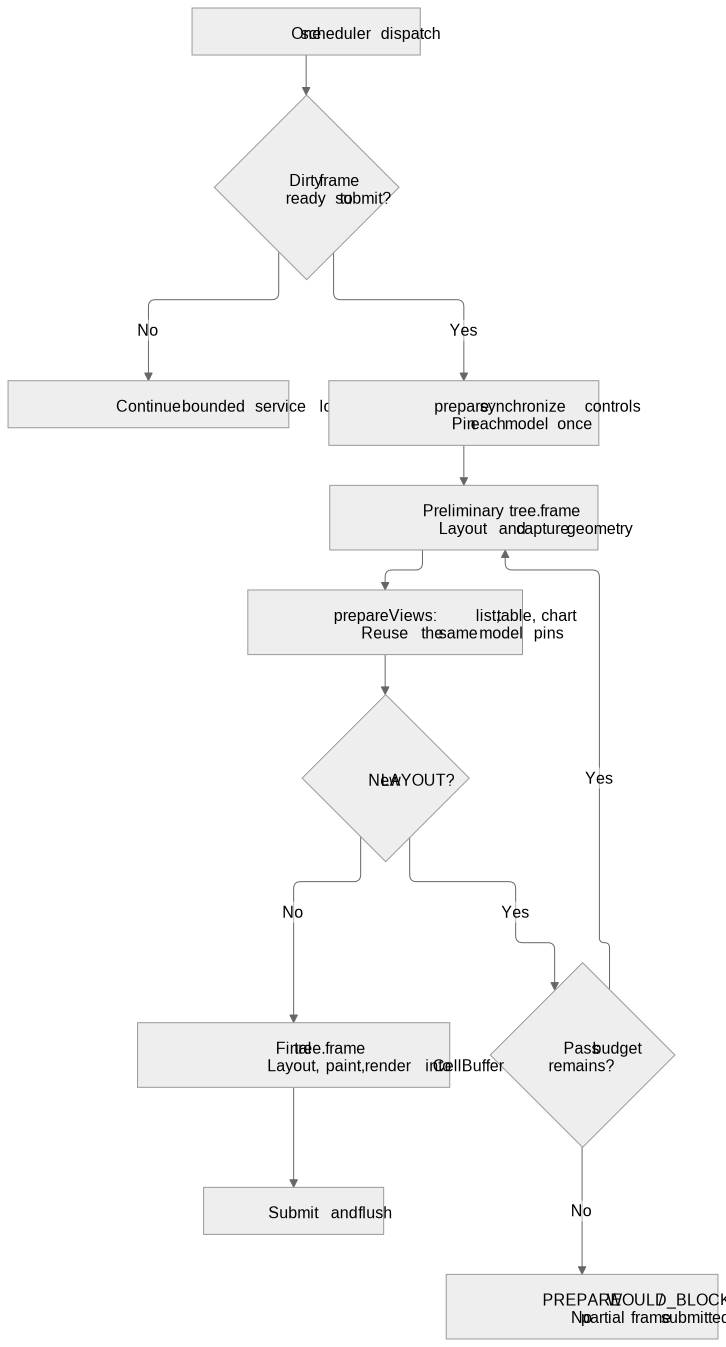
The first pending range request can invalidate layout while the second view still needs its dimensions. LayoutSnapshot owns identities and cell sizes, so both views see the same geometry even after that invalidation. It owns no widgets, model rows or borrowed render commands. viewport(node) checks the complete captured identity, including session and generation. It returns zero size for a node beneath a hidden ancestor. Disabled nodes remain visible.
Capture is a record of one layout, not a subscription to later tree changes. Use the supplied snapshot during that preparation pass. A subsequent mutation can make its geometry obsolete; it does not silently update. Removal still fails the view's existing checked tree access. Never reuse a snapshot across frames as if it described the current tree.
ApplicationOptions::maxPreparationPasses is a positive pass budget, default 3. Exhaustion ends preparation with ApplicationPhase::PREPARE and TreeError::WOULD_BLOCK; no partial frame is submitted. Hooks must converge: do not unconditionally invalidate layout on each call. Pure measurement and arrangement can run more than once; painting only happens in the final frame. An idle scene does not call either hook or redraw periodically.
For a full tree with N nodes, snapshot capture takes O(N log N) time and O(N) storage; it sorts by slot once and then looks up each full identity in O(log N). Copies share immutable storage. This cost is additional to the existing layout algorithm: the opt-in path performs at least one preliminary layout and one final layout. The pass budget bounds repetition, not the cost of an arbitrary user widget's measurement callback.
Providers and lifetime with explicit hooks
Each preparation overload returns the existing optional ModelRequest<T>. Send new receipts to the application's provider and retain/cancel them under the existing model contract. Do not dispatch the scheduler, repin the model or replace the scene's pin inside prepareViews, including retries. Enqueueing a completion is allowed; delivery belongs to a later scheduler dispatch. Same-revision range completions still need a fresh pin next frame.
Hidden list/table preparation cancels range work and releases prepared rows. The snapshot chart overload passes zero size for hidden nodes, cancelling its request through the existing chart path. A completion from an obsolete request does not revive the hidden view. Keep preparing registered hidden views if their outstanding work needs cancellation. A removed view is no longer a valid preparation target.
Views retain owning pin copies through rendering. The application must outlive its scene; model, provider and callback cleanup remain scene responsibilities. The overloads preserve TreeError rather than converting failures to a generic exception. A thrown hook is still reported by the runner's existing exception boundary. The default scene path has no preliminary layout pass.
Examples
The dashboard combines managed virtual views with a bounded data provider. For declarative view construction and named configuration, see declarative composition.
The installed-package lifecycle test exercises pending requests, an odd-width resize, ancestor hiding, cancelled late completions and independent sibling completions with the same data revision. Shared support supplies immutable rows and a finite terminal. See package testing for build instructions.
Provider responsibilities
Managed factories own model ranges and register view preparation. Column arrays and formatter lambdas infer their row type from the managed model. Applications supply custom layout, formatters, chart accessors, provider dispatch and retry policy. Explicit hooks and size overloads support custom preparation. Network loading policies must preserve bounded requests and immutable snapshots.