Loading...
Searching...
No Matches
Managed controls
<portals/managed.hpp> adds ManagedScene, a lifecycle owner for ordinary controls, custom widgets and opt-in virtual views. It uses the existing Application, WidgetTree, properties, bindings, router and style engine. The low-level APIs remain available. Nodes can be mounted imperatively or through the separate declarative composition API. Managed virtual factories add automatic preparation of lists, tables and charts without introducing reconciliation, a second widget tree or another runtime.
Ownership and execution
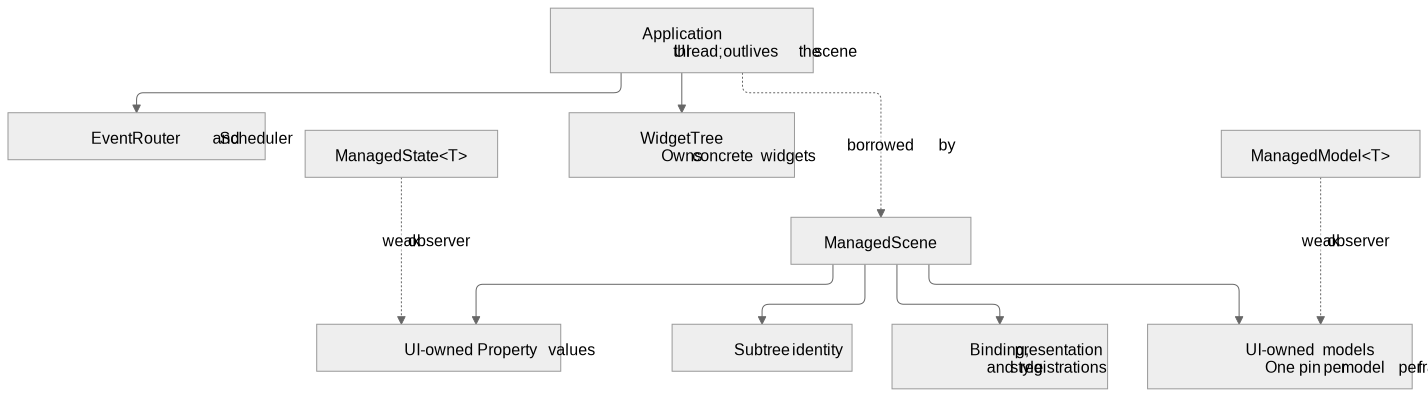
Create an Application, then ManagedScene::create(application, options). The optional ManagedOptions sets maxNodes, maxStates and maxModels; each must be greater than zero. Their defaults are 4096, 256 and 64. See setting scene limits. Node entries include removed registrations until the next preparation prunes them; state owners remain until scene destruction, while model owners remain until close. Exceeding an owner budget returns a typed TreeError::NODE_LIMIT. Add a Column, Row or custom layout below scene.root(), and create controls with scene.emplace<T>(parent, arguments...). The returned Node<T> remains the existing checked observer. Concrete custom types may be final; no additional widget base class is required.
The scene is noncopyable, nonmovable and UI-affine. Destroy it before its Application, outside callbacks and tree frames. Removing a child or ancestor from an admitted callback is supported; destroying either owner from that callback is not. An admitted callback retains its storage until it returns.
scene.state<T>(value) owns the Property<T> on the UI thread and returns a weak ManagedState<T>. Copies of the handle do not extend the state owner's lifetime. set() and snapshot() return the existing property results; UI affinity is checked before accessing the property. Use transitively immutable snapshots for cross-thread data. Do not use the weak handle as a worker-side mutable model interface.
Call scene.run() or scene.run(terminal) to retain complete managed errors. The Application still supplies options, width policy and the injected clock. The terminal overload supports the same deterministic replay contract as Application::run; no native terminal is required for tests.
Normal stop disconnects scene registrations, removes its subtree and destroys owned models. The scene retains properties until destruction so the caller can read final property snapshots. Model handles instead report CLOSED after stop. Writes after stop fail because the invalidation target is stale. After scene destruction, state operations on the creating UI thread return TreeError::CLOSED; wrong-thread operations still return WRONG_THREAD before checking expiration. Copying or destroying a handle is thread independent. Explicit close() is an idempotent fallible cleanup boundary; the destructor performs RAII cleanup.
Standard behavior and presentation
bind(editor, name, result, clipboard, validate), bind(checkbox, enabled, changed) and onClick(button, action) retain their registrations in the scene. Ordinary consumer code stores no individual binding tokens and calls no standard control synchronization functions. The scene obtains focus and synchronizes standard presentation only at the existing dirty-frame prepare boundary, before layout and paint. It does not add idle polling.
The property remains authoritative. Initial binding adopts its snapshot, and latest-snapshot synchronization recovers from rejected notifications. The exact PropertyUpdate<T> receipt still distinguishes a successful commit from failed notification admission. Resynchronization does not repeat a business callback. State invalidation must be PAINT or LAYOUT; NONE cannot guarantee this recovery and is rejected.
Line editing applies LineEditOptions::editMode equally to input, clipboard and fluent text changes; see editing modes:
- IMMEDIATE is the default: changed valid candidates publish without Enter.
- ON_COMPLETION confirms a dirty draft synchronously on blur or Enter.
- EXPLICIT preserves the previous opt-in draft/Enter behavior and keeps drafts on blur.
- Enter validates and commits only if the source revision still matches.
- Rejected validation or a revision conflict preserves the draft.
- Escape adopts the latest committed value.
- Ref<LineEdit>::clear() is a checked user edit applying the same mode and Undo history; immutable placeholder and protected display options are described in LineEdit.
- Invalid text and over-limit edits retain the previous draft; semantic rejection keeps the newly accepted intermediate text visible without publishing it.
The standard behavior executes before the result callback. Returning a callback error cannot undo an already committed checkbox toggle or edit. The LineEdit validator is the explicit commit veto. There is one event registration per node; onEvent is the custom-widget path, not a second registration to stack on a bound standard control. Callback storage uses std::function, so captures must be copyable; move-only captures are not promised by this version.
Styles and custom widgets
Managed Label, Button, CheckBox, LineEdit and KeyHints receive their natural style type names automatically; ui::plainButton uses Button. Their metadata also enables Control selector matching through StyleTarget::control. This flag adds one compatibility match; it does not introduce a type hierarchy. Custom Control subclasses retain the default Control type unless explicitly styled. Custom widgets use scene.style(node, target) and read computedStyle() while painting. Metadata is staged and installed as a batch. theme(sheet) uses the existing atomic style engine, flushing pending registrations before replacing the sheet. Explicit theme selection and initial focus remain application intent.
Explicit scene.style(node, target) replaces the target metadata; control defaults to false for such targets. Set it explicitly to keep the additional Control match. The recipe .style(target) uses the same replacement contract, with its existing ID modifier rules; .id() preserves the other target fields. Completing a cold List, Table or Chart preserves its ID, classes and nonempty custom type, assigning the default type only when none was supplied.
One style engine owns a node at a time. Do not bind the same managed node to an independent StyleEngine. The existing precedence remains widget defaults below matching stylesheet rules; this layer does not introduce a local-override cascade, hierarchy selectors, inheritance or new PSS syntax.
Register a custom event handler with onEvent(node, callback), returning expected<EventReply, TreeError>. Register custom presentation work once with onPrepare(node, callback), returning expected<void, TreeError>. The latter receives the concrete widget and the recovered focus observer. It reads domain state, updates retained presentation when needed and requests the appropriate invalidation. The scene invokes it; the application does not manually call it before each frame. Custom onPrepare runs before layout and does not supply virtual-view geometry. Use the dedicated virtual factories for automatic preparation from the arranged size. Painting must still consume only prepared presentation.
Managed virtual views
model<T>(initialSnapshot, options) creates an existing Model<T> owned by the scene and returns a weak ManagedModel<T>. The handle exposes publisher() on UI so provider code can copy the existing worker-safe publication endpoint. Snapshots and rows must satisfy the immutable model contract. Handles copied outside the scene do not extend model ownership, and models cannot be shared between managed scenes through these factories.
virtualList, virtualTable and chart accept that handle, create independent range consumers, and register preparation plus the standard List, Table or Chart style target. Lists and tables also own their standard input bindings. No per-view token, manual style registration, pin or size calculation is needed. The usual style() and theme() operations remain available for customization.
The scene pins each model once during ordinary dirty-frame preparation and uses that pin for every registered view and bounded layout retry. An optional provider handler receives borrowed frame/request arguments after each successful view preparation, in registration order. Copy pending requests before retaining them; provider scheduling and rejected-completion retry remain application policy. A missing handler with pending work reports PREPARE / INVALID_ARGUMENT and cancels the unowned request. Do not mutate the managed registry or dispatch the scheduler from a preparation handler.
Hiding cancels range work; disabling keeps preparation but suppresses input; removal retires the consumer. Closing the scene destroys model owners and closes their endpoints. A factory failure removes its attempted child, preserving earlier children. The virtual preparation guide describes callback ordering, lifetime and failures. Explicit ApplicationScene hooks and low-level preparation helpers remain supported.
Errors and partial construction
Managed operations return expected<..., ManagedError>. The error retains its phase, node identity and original TreeError, StyleError or ApplicationError. It can also retain an independent runner/restoration error and cleanup failure. ManagedError::cause keeps its original three variant alternatives. The optional text detail retains an exact TextError, including its byte offset; the optional resource detail retains an exact TextResourceError. Text/resource adapters can keep a compatible tree category in cause while preserving the original typed detail. Managed diagnostics includes the shared <portals/text_resource.hpp> resource categories without importing text factories. Existing visitors over the tree/style/application variant remain valid. The run wrapper is required when the caller needs these complete details; calling the ApplicationScene compatibility hooks directly cannot carry the whole error object through their TreeError return type.
Business callbacks return their errors explicitly. Throwing from a callback still follows the existing CALLBACK_FAILED boundary; using .value() there would discard the original expected error. The scene-level onInput callback returns expected<bool, ManagedError> so a failed theme replacement can retain its full style error. true consumes the event before routing. Mutable captures retain their state between events. Replacing the interceptor or closing the subtree from inside it retains the active callback until it returns.
An admitted custom preparation callback may remove its own node. Successful removal does not suppress an explicitly returned error or a translated exception. Checked insertion also revalidates its result after deferred unmount callbacks have run; it cannot return a child already removed by that cleanup.
Failed construction removes the attempted child; earlier successful children remain scene-owned. Destroying the scene cleans a partially built form. This is resource cleanup, not rollback of external effects performed by constructors, mount hooks or business callbacks.
Bounded scene diagnostics
ManagedOptions::diagnostics configures maxErrors, maxContexts and maxContextBytes; each must be greater than zero. Their defaults are 64, 8 and 1024. The scene constructs a fixed array of error slots and a separate overflow slot before mounting its root, including the empty context containers. This finite construction cost allows reporting without creating or moving containers, including MSVC Debug iterator proxies. Invalid or unrepresentable budgets return INVALID_ARGUMENT; failed allocation returns NO_MEMORY without mounting a partial subtree. The count limit bounds the error history; the context count and combined label-byte limit bound the owning causal trace of each error.
reportError(error, contexts, origin) collects an explicit error and notifies the optional onError observer. It does not request a frame, stop the runner or select a recovery policy. Checked setup calls continue returning their explicit expected errors and are not automatically duplicated in the history. Managed runtime failures are recorded through the existing first-failure path, which still requests orderly shutdown and returns the original failure from run(). Successful operations and ordinary redraws do not create diagnostic entries.
Each ManagedDiagnostic owns a ManagedError and its copied ManagedDiagnosticContext breadcrumbs. A context contains operation, name, scope, expectedType and the original origin. Contexts are copied in supplied order, retaining up to maxContexts; label bytes are copied in the field order above until the shared maxContextBytes budget is exhausted. Truncation is a byte-prefix policy, so a truncated UTF-8 label may need escaping when formatted. contextsTruncated identifies either limit. Source locations are stored by value under the standard source-location contract. This is a causal trace, not a physical call stack. Deferred operations must capture an origin at registration and pass it when reporting; a default report origin only identifies the reportError call site. No formatted report or borrowed exception is stored.
ManagedOptions options;
options.diagnostics.maxErrors = 32;
auto created = ManagedScene::create(application, options);
if (!created) {
return std::unexpected(created.error());
}
auto scene = std::move(*created);
auto registered =
scene->onError([](const ManagedDiagnostic &diagnostic) {
// Inspect typed fields here; the reference is
// borrowed for this call only.
// Presentation/output remains application policy.
});
if (!registered) {
return std::unexpected(registered.error());
}
std::array contexts{ManagedDiagnosticContext{"lookup",
"message",
"form",
"LineEdit",
std::source_location::current()}};
auto reported = scene->reportError(
ManagedError{
ManagedPhase::STATE,
{},
TreeError::INVALID_ARGUMENT,
{},
{}},
contexts);
if (!reported) {
// Handle WRONG_THREAD or CLOSED explicitly.
}
Scene & onError(ManagedErrorHandler observer, std::source_location origin=std::source_location::current()) &
After maxErrors entries, the oldest errors survive and droppedErrors increases. The observer still receives the original overflowing error and report origin in an allocation-free reused diagnostic with storageOverflow = true; its contexts are omitted and contextsTruncated is set if contexts were supplied. When copying context storage fails, the stored original error and origin survive, the partial trace is discarded, contextUnavailable is set and contextFailures increases. Recording an error without contexts and the overflow fallback require no allocation after successful scene creation. Construction of caller arguments and allocations performed by an observer happen outside that guarantee.
onError owns its copyable callback and mutable captures. It runs synchronously on UI after recording and can inspect diagnostics(). It must not retain a reference to the borrowed diagnostic, its labels or context storage. A thrown exception sets the record's observerFailed flag and increments observerFailures, preserving the original cause and stop policy. Nested reportError calls are collected, set notificationSuppressed, and increment suppressedNotifications; they do not recursively invoke the observer and are available through inspection/draining. Overflowing temporary flags are only available during their observer call; the batch retains the counters. Counters saturate at size_t's maximum.
Observer registration, scene mutation, close(), clearErrors() and drainErrors() return WOULD_BLOCK while an observer is active. Replacement or clearing outside a call releases the prior callback; close releases it after marking the scene closed. Immediate managed-error notifications occur before terminal restoration and never write mandatory stdout/stderr or display a dialog. After shutdown, run() adds independent application/restoration and cleanup details to its retained first runtime diagnostic. If that record was cleared or drained earlier, the complete final error is appended instead of rewriting an unrelated entry. An application-only runtime error is collected at that final boundary. No observer is called after close.
diagnostics() copies an owning ManagedDiagnosticBatch; drainErrors() copies then clears it, preserving the constructed slots and context-container storage. Copies are constructed directly at the error boundary; no noexcept container move is relied on for allocation handling. Allocation failure returns NO_MEMORY and leaves the history/counters unchanged. clearErrors() clears history and counters without allocating. Neither clearing method resets a runtime first failure or changes shutdown policy. Inspection, clear and drain remain available after close, with batch.closed = true; reporting and registration return CLOSED. All these operations check UI affinity first and return WRONG_THREAD without mutating the collector or calling an observer. These are checked scene operations; a detached/worker-safe property channel belongs to the later property facade, not this collector foundation. The scene and application must remain alive throughout any operation.
Examples and verification
For application code, start with declarative composition and the fluent gallery. These scene descriptions use the managed control factories internally.
The installed-package tests compile controls against a relocated installation using find_package(Portals CONFIG REQUIRED) and portals::core. The form fixture exercises editing, validation, state updates, focus, theme changes and custom widget behavior. Replay support supplies a finite terminal and scripted input. The typed-error scenario checks the original error, phase, node and transport cleanup.