Loading...
Searching...
No Matches
Edit the current record
Русская версия · Shared navigation · Model switching
Use an edit session when a list selects a record and a form edits its fields. The session owns the draft and its editing history independently of the temporary controls. Returning to a record restores its draft; changing the current row does not redirect an edit that started on the previously displayed record.
Include <portals/ui_model_edit.hpp> for this optional API. For a declaration containing multiple typed fields, use current-record forms.
Use session and field operations on the UI thread, including retained-draft inspection and receipt application. Background work receives owning request values; deliver its receipt through the existing UI delivery path before calling applyReply(). Shared ownership does not make the mutable session thread-safe.
A city directory
Choose a city, change its name or country, and choose Save. In this example the session uses EXPLICIT: moving to another city keeps the first city's draft. Return to it to continue editing. Cancel restores the current record's accepted value. Use Up/Down while the list has focus, and Tab to move between the list, fields and buttons. F2 saves, F3 cancels, and F10 or Ctrl+C exits.
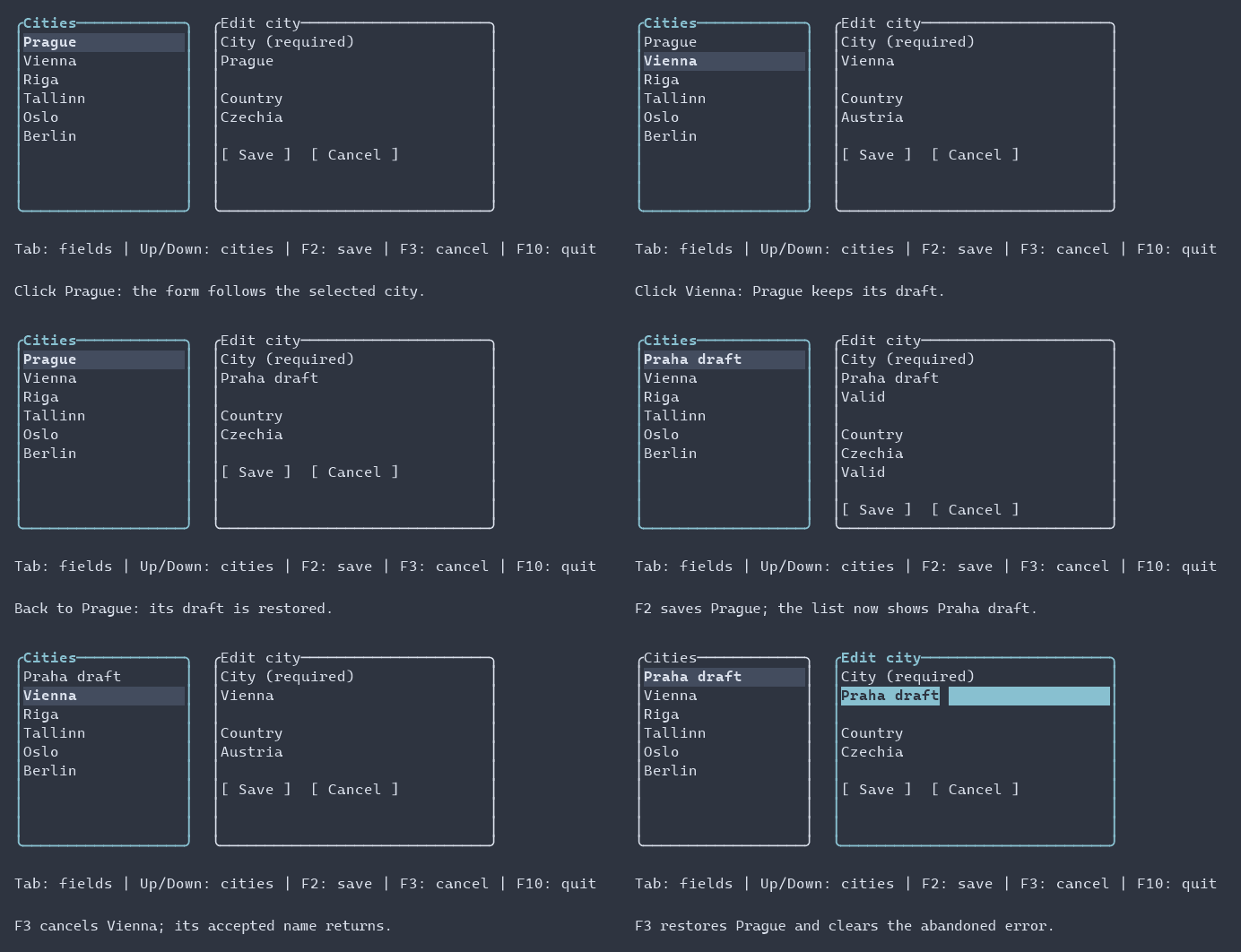
Edit a city, navigate away and restore its draft
// Copyright (c) 2026 ttldtor.
// SPDX-License-Identifier: BSL-1.0
#include <portals/ui.hpp>
#include <portals/ui_model_edit.hpp>
#include <portals/ui_style.hpp>
#include <array>
#include <string>
using namespace portals;
struct City {
std::string name;
std::string country;
bool operator==(const City &) const = default;
};
int main() {
auto cities = ui::model(std::array{
City{"Prague", "Czechia"}, City{"Vienna", "Austria"}, City{"Riga", "Latvia"},
City{"Tallinn", "Estonia"}, City{"Oslo", "Norway"}, City{"Berlin", "Germany"}
});
auto navigation = ui::navigation(cities);
auto edit = ui::edit(navigation, {.mode = EditMode::EXPLICIT});
// clang-format off
return ui::scene(ui::vbox(LinearOptions{.gap = 1},
ui::hbox(LinearOptions{.gap = 2},
ui::virtualList(navigation, &City::name)
.width(20).framed("rounded", "Cities"),
ui::vbox(LinearOptions{.gap = 1},
ui::formField("City", edit.field(&City::name), {.required = true}),
ui::formField("Country", edit.field(&City::country)),
ui::hbox(LinearOptions{.gap = 2},
ui::button("Save", [edit] { return edit.commit(); }),
ui::button("Cancel", [edit] { return edit.cancel(); })))
.height(11),
ui::label("Tab: fields | Up/Down: cities | F2: save | F3: cancel | F10: quit"))
.maxWidth(74).fitHeight())
| ui::theme(nordTheme())
| ui::onKey("F2", [edit] { return edit.commit(); })
| ui::onKey("F3", [edit] { return edit.cancel(); })
| ui::onKey("F10 | Ctrl+C", ui::quit)
| ui::runApp();
// clang-format on
}
StyleSheet nordTheme()
@ EXPLICIT
Keep a draft until Enter or programmatic activation; focus loss preserves it.
Definition line_edit.hpp:30
When values reach the model
The session reuses the ordinary editor's modes and validation:
| Mode | Publication and navigation |
|---|---|
| IMMEDIATE | Valid input reaches the model during editing. Invalid intermediate text remains a draft of its original record. |
| ON_COMPLETION | Completion attempts to publish. A user transition is rejected while validation, conflict or pending completion prevents leaving the existing target. |
| EXPLICIT | Navigation retains drafts by record. Commit applies the current edit; cancel discards its draft in favor of the current accepted value. |
A forced deletion cannot be vetoed. An uncommitted draft remains associated with the missing target for explicit inspection or recovery; a nearby surviving record is a reading destination, never a replacement write target. Closing the source prevents further writes. Closing the edit owner does not promise automatic persistence: longer storage requires an explicit application-owned export or owner.
Undo and Redo belong to the original record and field. They are not commit/cancel, and an external change cannot be overwritten by applying the old history silently. Retention is bounded. Admission failure keeps the previous draft and current position rather than evicting dirty input to make room.
EditOptions defaults to 128 retained field targets and a 4 MiB logical owning- payload budget. It accounts for retained values and text/history capacities; allocator bookkeeping, temporary preparation and memory owned by callers or backends are outside that budget. It is not a process RSS limit. Ordinary editor text limits also continue to apply.
Fields and source guarantees
field(&City::name) is a process-local selector. An explicit key such as field("city.name", &City::name) gives an adapter an owning schema identity. A member pointer is not a portable field identifier.
A write is qualified by the resource and lineage, bound model incarnation (sourceSession), edit-request namespace (session), exact record, field, expected version and request sequence. The model incarnation is an SDK identity, not the remote server's generation. Conditional endpoints check the precondition together with applying the write. An update to another record need not conflict; record-level versioning may conservatively conflict on another field of the same record. Direct model writes are external changes to an active draft.
Request admission and backend acceptance are different outcomes. A pending reply does not clear newer dirty input. Late replies remain attached to their original target and cannot overwrite a newer accepted result. The session reports each field separately through lastResult(). A successful checked commit() means the command was admitted; inspect the per-field receipts to distinguish pending work from acceptance. commit() and cancel() return the existing EditorCommandResult, also used by editor Undo/Redo. Return it directly from a managed handler; use .result() when explicit checked error handling is needed. Separate field submissions are not one atomic transaction.
In a bound text field, Escape cancels that field. The example's Cancel button and F3 cancel the current record's fields. If a refreshed accepted value exceeds the retention budget, cancellation reports a recoverable limit and preserves the existing draft.
Cancel removes the local draft; it does not withdraw or undo a write already admitted by a backend. That request remains pending, and new input for the same field waits for its receipt. Discarding a live in-flight target returns a checked WOULD_BLOCK; after source closure its orphan can be inspected and discarded.
An asynchronous adapter must also check its own backend incarnation together with applying the write. Ignoring an old UI receipt cannot repair a stale write that a backend has already applied.
Read-only sources keep navigation and readable fields. Having no current record does not make scene construction fail. External adapters use bounded field-value access and the existing worker/delivery path, without loading the full model or performing blocking I/O in an input handler. Large text and custom widget mapping have their own capabilities; an ordinary field binding does not imply a full in-memory copy is suitable for every source.
For a retained text editor, field.draftText(originalTarget) copies its exact owning bytes without parsing or source I/O. This permits explicit recovery of a malformed typed draft after its record was removed. It returns nullopt for a target without text state and preserves checked affinity/liveness errors.
For text-document selection, bookmarks and savepoints, see text anchors.