Loading...
Searching...
No Matches
Map a form to the current record
Русская версия · Record edit sessions · Field validation
Use <portals/ui_model_form.hpp> when a list selects a record and a form edits its members. A form is an ordinary Column containing real FormField and LineEdit controls. It shares the navigation and edit session already used by the list; application code does not copy values when current changes.
A city form
The workspace combines a city list, an accepted-values table and a draft form. The form edits a required name and a nonnegative order count; Country remains readable while user editing is blocked. Europe/Asia buttons or F6/F7 switch the shared source. F2 saves the current record, F3 cancels its drafts, F4 selects English, F5 selects Russian, and F10 exits. See model workspaces for the complete interaction sequence. In EXPLICIT mode, moving to another city retains the first city's draft and Undo/Redo history. A malformed count stays visible until corrected or canceled.
// Copyright (c) 2026 ttldtor.
// SPDX-License-Identifier: BSL-1.0
#include <portals/table_column.hpp>
#include <portals/ui.hpp>
#include <portals/ui_model_form.hpp>
#include <portals/ui_style.hpp>
#include <array>
#include <format>
#include <string>
using namespace portals;
enum class Region {
EUROPE,
ASIA
};
struct City {
std::string name;
int orders{};
std::string country;
bool operator==(const City &) const = default;
};
int main() {
auto europe =
ui::model(std::array{City{"Prague", 12, "Czechia"}, City{"Vienna", 25, "Austria"}, City{"Riga", 18, "Latvia"},
City{"Tallinn", 9, "Estonia"}, City{"Oslo", 31, "Norway"}, City{"Berlin", 45, "Germany"}});
auto asia =
ui::model(std::array{City{"Tokyo", 48, "Japan"}, City{"Seoul", 36, "South Korea"}, City{"Taipei", 27, "Taiwan"},
City{"Kyoto", 15, "Japan"}, City{"Osaka", 22, "Japan"}, City{"Busan", 14, "South Korea"}});
auto navigation = ui::navigation(europe, {.readingAnchor = true});
auto edit = ui::edit(navigation, {.mode = EditMode::EXPLICIT});
auto russian = ui::model(false);
auto region = ui::bySource<City, Region>({{europe, Region::EUROPE}, {asia, Region::ASIA}});
return region(position).transform([](Region value) {
return value == Region::EUROPE ? std::string("Europe") : std::string("Asia");
});
};
auto translate = [](std::string_view key, bool inRussian) -> std::expected<std::string, TextResourceError> {
if (key != "orders") {
return std::unexpected(TextResourceError::MISSING_RESOURCE);
}
return inRussian ? "Заказы" : "Orders";
};
// clang-format off
return ui::scene(ui::vbox(LinearOptions{.gap = 1},
ui::label(navigation.current(), regionCaption),
ui::hbox(LinearOptions{.gap = 2},
ui::vbox(LinearOptions{.gap = 1},
ui::virtualList(navigation, &City::name)
.height(6).framed("rounded", "Cities"),
ui::virtualTable(navigation,
tableColumn("City", &City::name, 16),
tableColumn("Orders", &City::orders, 7))
.height(7).framed("rounded", "Accepted values"))
.width(28),
ui::form(edit,
ui::field("City", &City::name).required(),
.validate([](int count) { return count >= 0; }),
ui::field("Country (read only)", &City::country).readOnly(),
ui::hbox(LinearOptions{.gap = 2},
ui::button("Save", [edit] { return edit.commit(); }),
ui::button("Cancel", [edit] { return edit.cancel(); })),
ui::hbox(LinearOptions{.gap = 2},
ui::button("Europe", [navigation, europe] { navigation.model(europe); }),
ui::button("Asia", [navigation, asia] { navigation.model(asia); })))
.height(17),
ui::label("F2: save | F3: cancel | F4: English | F5: Russian | F6/F7: source | F10: quit"),
ui::label("Choose a city to edit. Save publishes its draft; switching keeps it with that city."),
ui::label(navigation.current(), [regionCaption](const NavigationPosition &position) {
return regionCaption(position).transform([](const std::string &name) {
return std::format("{} keeps its current city and reading place.", name);
});
}))
.maxWidth(88).fitHeight().framed("rounded", "City orders workspace"))
| ui::theme(nordTheme())
| ui::onKey("F2", [edit] { return edit.commit(); })
| ui::onKey("F3", [edit] { return edit.cancel(); })
| ui::onKey("F4", [russian]() mutable { russian.value() = false; })
| ui::onKey("F5", [russian]() mutable { russian.value() = true; })
| ui::onKey("F6", [navigation, europe] { navigation.model(europe); })
| ui::onKey("F7", [navigation, asia] { navigation.model(asia); })
| ui::onKey("F10 | Ctrl+C", ui::quit)
| ui::runApp();
// clang-format on
}
StyleSheet nordTheme()
ui::ValueText text(std::format_string< const ui::detail::TextArgumentValue< Args > &... > pattern, Args &&...args)
Declare live formatted text over explicit scalar roots, fields or value properties.
Definition ui_value_text.hpp:567
@ MISSING_RESOURCE
The caller's resolver could not find the requested resource key.
Definition text_resource.hpp:10
TableColumn< T > tableColumn(TableColumnOptions options, Projection projection, Formatter formatter)
Compose an owning typed column from explicit projection and text formatting.
Definition table_column.hpp:84
constexpr TextValue i18n(std::string_view key)
Copy a resource key for later resolution through an explicit caller.
Definition text_value.hpp:227
@ EXPLICIT
Keep a draft until Enter or programmatic activation; focus loss preserves it.
Definition line_edit.hpp:30
Build an application against portals::core as shown in Connecting an application. The source needs C++23. For two ordinary string fields, this smaller example uses the same directory and save/cancel behavior as the record-edit guide:
// Copyright (c) 2026 ttldtor.
// SPDX-License-Identifier: BSL-1.0
#include <portals/ui.hpp>
#include <portals/ui_model_form.hpp>
#include <portals/ui_style.hpp>
#include <array>
#include <string>
using namespace portals;
struct City {
std::string name;
std::string country;
bool operator==(const City &) const = default;
};
int main() {
auto cities = ui::model(std::array{City{"Prague", "Czechia"}, City{"Vienna", "Austria"}, City{"Riga", "Latvia"},
City{"Tallinn", "Estonia"}, City{"Oslo", "Norway"}, City{"Berlin", "Germany"}});
auto navigation = ui::navigation(cities);
auto edit = ui::edit(navigation, {.mode = EditMode::EXPLICIT});
// clang-format off
return ui::scene(ui::vbox(LinearOptions{.gap = 1},
ui::hbox(LinearOptions{.gap = 2},
ui::virtualList(navigation, &City::name)
.width(20).framed("rounded", "Cities"),
ui::form(edit,
ui::field("City", &City::name).required(),
ui::field("Country", &City::country),
ui::hbox(LinearOptions{.gap = 2},
ui::button("Save", [edit] { return edit.commit(); }),
ui::button("Cancel", [edit] { return edit.cancel(); })))
.minWidth(32).framed("rounded", "Edit city"))
.height(11),
ui::label("Tab: fields | Up/Down: cities | F2: save | F3: cancel | F10: quit"))
.maxWidth(74).fitHeight())
| ui::theme(nordTheme())
| ui::onKey("F2", [edit] { return edit.commit(); })
| ui::onKey("F3", [edit] { return edit.cancel(); })
| ui::onKey("F10 | Ctrl+C", ui::quit)
| ui::runApp();
// clang-format on
}
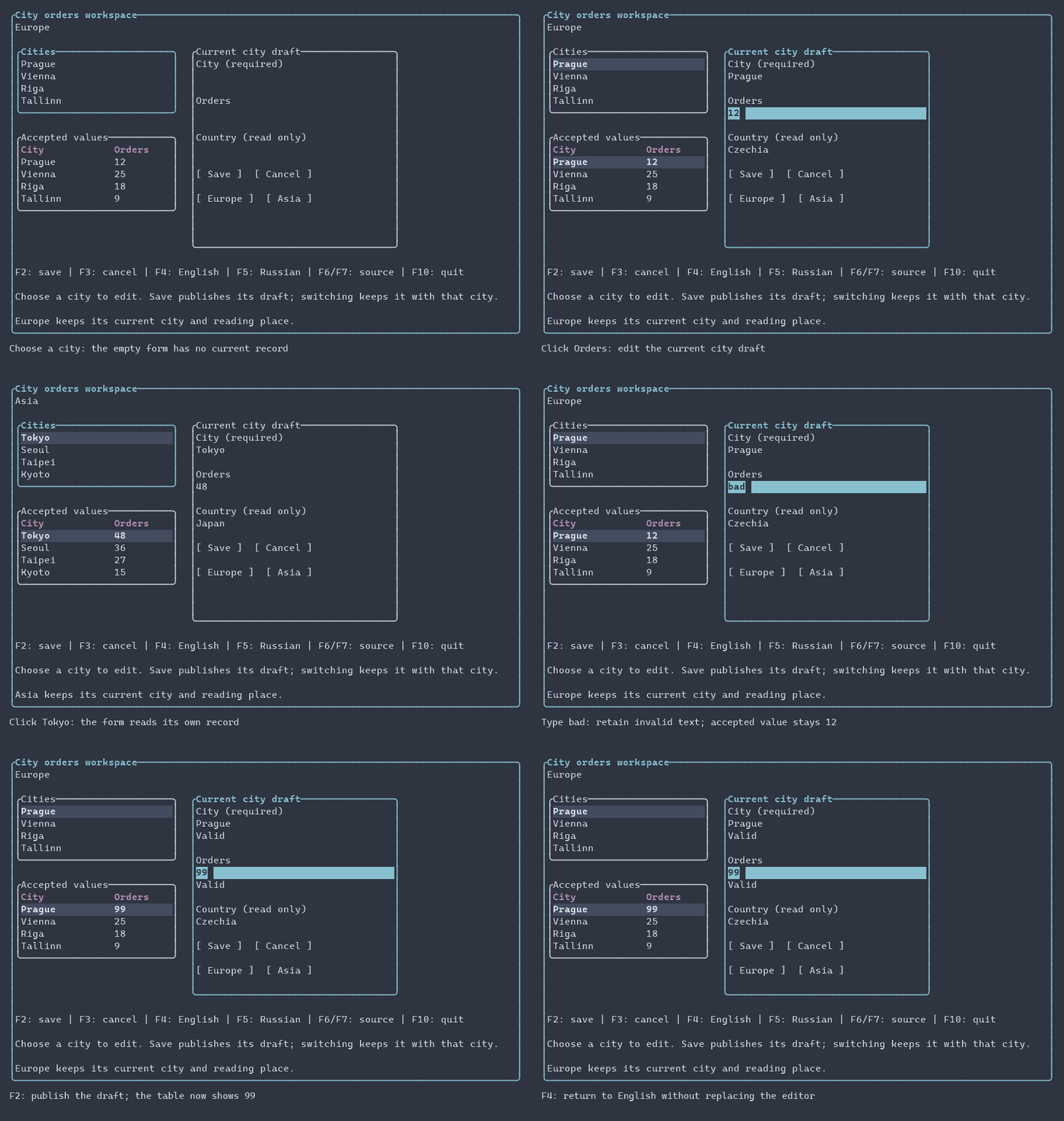
A typed city form: validation, cancel, retained drafts and language changes
Field declarations
ui::field(caption, &City::orders) owns its caption and mapping configuration. The member pointer selects a local C++ member; it is not a persistent schema key. Use .key("city.orders") when an external adapter needs an explicit schema identity. Register that adapter with edit.field("city.orders", &City::orders, endpoint) before constructing the form. Both declarations then share the same field definition and exact qualified write targets.
| Declaration | Behavior |
|---|---|
| .required() | Show the native required marker and reject empty scalar text at publication |
| .validate(rule) | Apply an owning typed synchronous rule in addition to existing field validation |
| .readOnly() | Block user editing through the native editor policy; explicit programmatic commands retain their checked behavior |
| .options(config) | Replace the ordinary FormFieldConfig, including text/async rules, help, messages and editor limits |
| .reference(ref) | Publish an ordinary Ref<FormField> after the entire subtree mounts; ref.editor() observes its LineEdit |
| .codec(codec) | Use explicit owning scalar parse/format callbacks |
| .editor(factory) | Supply an actual custom editor recipe with an explicit typed binding |
Modifiers are applied in call order. In particular, .options(...) replaces settings established by an earlier .required() or .readOnly() call. A form accepts ordinary consuming widget recipes alongside field declarations, so its Save/Cancel row can be a direct child. It uses gap one by default; its returned Description<Column> supports the usual layout, sizing, framing and setup operations.
The default mapper supports std::string, integral types except bool, and floating-point types supported by charconv. Numbers use locale-independent decimal charconv conversion and require a complete candidate. Whitespace, a suffix, overflow, NaN and infinity are rejected; no prefix is silently accepted. Use a custom codec for an enum, a domain value or another textual representation. The built-in endpoint accounts for strings and trivially copyable values; other owning types need an explicit endpoint implementing their ownedBytes() contract. Unsupported owning values without a codec or factory fail checked mount with INVALID_ARGUMENT.
Modes, validation and identity
The form preserves its session's IMMEDIATE, ON_COMPLETION or EXPLICIT mode. Keyboard input, paste, fluent text assignments and bound typed field assignments use the existing publication path. Required/text checks and typed validation run before a candidate reaches the model. Async validation uses the ordinary FormFieldConfig::validateAsync worker path and its candidate/message bounds. No validator runs during painting. Form-required/text/mapping rules belong to each mounted editor; creating an unused recipe does not change another editor or the explicit rule registered through EditField::validate().
For several editors of the same field, session commands and typed field setters use the existing preferred binding: the first eligible live FormField in binding registration order, then a plain editor if no FormField is available. Rules from separate editors are not implicitly intersected. Direct Ref edits use that control's policy. Removing the preferred editor lets the next eligible binding take over. An async draft retains its generation's approval requirement after editor removal; a newly mounted editor can supply a replacement policy, and Cancel discards local input.
A malformed numeric draft has owning text and history even though it has no typed value. Inspect its bytes through ref.text().get(); the field snapshot's typed draft is empty when parsing fails. For a retained target that is no longer current, field.draftText(originalTarget) explicitly copies its editor bytes without parsing or contacting the source. This also recovers malformed text from an orphan after record deletion or source closure. It returns nullopt when the retained target has no text editor state; the owning copy survives navigation and discard. Validation status and messages remain attached to that exact record. Cancel adopts its admitted accepted value and resets local history; Undo/Redo retain their ordinary editing meaning.
Read-only models supply readable fields and keep navigation usable. With no current record, the standard editors are empty and inactive; form construction succeeds. A descriptor's .readOnly() blocks user editing independently of source write capability. It does not grant a write capability to a read-only source.
When deletion resolves navigation to a nearest surviving current row, the form creates a new exact target for that resolved row's stable identity. The previous record's retained targets and raw input remain independent; Save cannot transfer an orphan draft into its replacement. Navigation retains its nearest-resolution diagnostic.
Drafts, pending requests and replies retain the existing resource/session/record/ field/version/sequence qualification. A late reply for the previous record cannot replace the newly displayed record. Save submits per field, and edit.lastResult() exposes partial acceptance or pending work. The form adds no multi-field transaction guarantee. See session lifetime and replies for retained targets, conflicts, source closure and cancellation of local input.
Captions and language changes
Pass a literal, TextValue, an existing live scalar caption source or a ValueText expression directly to ui::field. The mapper mounts the normal Label recipe, so delivery, errors and ownership follow the existing caption API. A live required caption has a separate native required-marker label beside it.
For language changes, the typed example uses text(i18n("orders"), translate, russian): the locale model is an explicit dependency of the existing resolver. Changing it updates the caption. A bare TextValue uses its normal resolution policy; the form adds no ambient locale or scheduler. See Live captions.
Custom codecs and editors
A codec owns format(const Value&) -> expected<string, TreeError> and parse(string_view) -> expected<Value, TreeError>. Return INVALID_ARGUMENT for a rejected complete candidate. Other errors follow the checked editor diagnostic path. Callbacks run synchronously on the UI thread, must be short and non-reentrant, and must not retain borrowed input. Exceptions use the existing mount/input error boundary. Formatting owns the complete scalar output.
One retained field has one text representation and history. Copies of a mapping share their codec owner. Direct lineEdit(field, codecOwner) and formField(caption, field, codecOwner, config) accept a shared_ptr<const ui::EditTextCodec<Value>>. Reuse that owner when mounting another editor for the field. A different codec owner, or adding a representation after the field was activated without one, fails checked mount with INVALID_ARGUMENT. It cannot reinterpret an already admitted draft/history.
A factory receives EditField<Row, Value> and the descriptor's requested user read-only policy. For example, this owning factory chooses the existing typed text editor and explicitly stages its native policy; codecOwner is an already created owning codec:
ui::field("Orders", &City::orders).editor(
[codecOwner](ui::EditField<City, int> field, bool readOnly) {
return ui::lineEdit(std::move(field), codecOwner).readOnly(readOnly);
});
UI-thread-affine typed field capability with exact-target retained inspection and discard.
Definition ui_model_edit.hpp:139
The wrapper supplies the real FormField, caption, help, appearance and required marker. A custom editor supplies its property-to-field binding, user read-only policy, source-readonly presentation, value validation, history and focus behavior. The marker alone does not implement custom value validation. Ordinary text/async editor options are used by the default mapper; a custom factory configures its own editor. A mapping's .validate() accompanies the field copy passed to its factory. field.set() checks this local typed rule before admitting a candidate; the factory keeps its own rejected UI input. Passing that field to the native typed LineEdit also preserves the rule through input and session publication. It does not replace the shared model rule. No arbitrary widget property is connected automatically.
Scalar text limits
The default mapper is a bounded single-line scalar editor. Its existing LineEditOptions::limits apply; defaults allow 4096 input bytes. Retained values, drafts and history also use the session's independent EditOptions budget. A built-in owned/read-only field checks a selected string's size against the mounted scalar editor's byte bound before copying that member. Oversized input reports INVALID_ARGUMENT; it is never truncated. An unbound typed field keeps its ordinary retention contract, without a new editor-length limit.
An external EditEndpoint::read supplies an owning field value and must enforce its own bounded access contract before producing it. A codec formats a complete scalar; it does not stream a huge document. For windowed text or binary data, choose a capability-aware editor/source through an explicit factory, for example an existing document viewer for read-only windowed content. A factory is an extension point, not automatic support for large-text editing or for every widget property.