Loading...
Searching...
No Matches
Architecture
Portals is a C++23 retained terminal UI library. Start with the complete application for the fluent ui::Scene entry point: the facade owns the application and managed scene, builds the controls lazily, and runs the same scheduler/tree/router described here. Application owns one UI runtime and services its terminal synchronously on the creating thread. The scene owns application models, scoped bindings and providers. Workers may publish immutable data through bounded scheduler endpoints; they cannot edit the widget tree. Getting started links a simple main and the runnable examples; limitations defines release boundaries.
Components and boundaries
Planned multiline editor contracts describe a future document/view extension and its language-provider boundaries. They do not change the implemented components below.
Components and data flow
| Component | Implemented responsibility |
|---|---|
| Application | Own scheduler/tree/router; coordinate bounded input, dispatch, preparation, frames, output and orderly cleanup |
| ApplicationScene | Borrow UI services; own domain models/bindings/providers; synchronize and prepare views; stop owned producers |
| TerminalSession / InputDecoder | Native bounded I/O and semantic input; Windows events are not decoded twice |
| Scheduler | Separate CONTROL/DATA capacities and dispatch budgets; timers, publication and scoped cancellation |
| EventRouter | Focus, hit testing, action resolution and checked delivery through the existing dispatcher |
| WidgetTree | Own widget storage, identities, geometry and invalidation; expose checked callback borrows |
| Property<T> / Model<T> | Immutable value/revision and snapshots; explicit observers, scoped ranges and request receipts |
| Layout, controls, virtual views, Chart<T> | Measure/arrange/paint; prepare coherent bounded presentation before frames |
| Typed themes / PSS v0 | Resolve styles and apply validated atomic theme updates; no second rendering path |
| Renderer / CellBuffer | Consume clipped borrowed commands into owning desired cells inside the frame |
| FrameWriter | Encode/diff, retain pending output, advance committed state only after consistent acceptance |
| Diagnostics | Optional bounded causal metadata; owning snapshot and export chosen by the application |
The core uses standard-library and native OS interfaces. Grapheme processing uses the private vendored utf8proc dependency. Doxygen, fuzzers and test oracles are build tools, not runtime dependencies. See text, render, terminal, styles and chart.
Public headers and implementation boundary
The fluent API is split across public headers. ui.hpp is the supported compatibility umbrella for applications that use the broad UI surface. A smaller translation unit may include only the subjects it uses, for example:
#include <portals/ui_controls.hpp>
#include <portals/ui_layout.hpp>
#include <portals/ui_scene_pipeline.hpp>
Each subject header is self-contained; leaf headers do not include ui.hpp. Choosing fewer headers can reduce the declarations visible to a translation unit, but a shorter include list is not evidence of a faster build. The library does not require precompiled headers or C++ modules. Fluent recipes, handlers and their templates are header-dependent, so changing a consumer handler rebuilds that consumer translation unit. It does not require rebuilding an installed SDK.
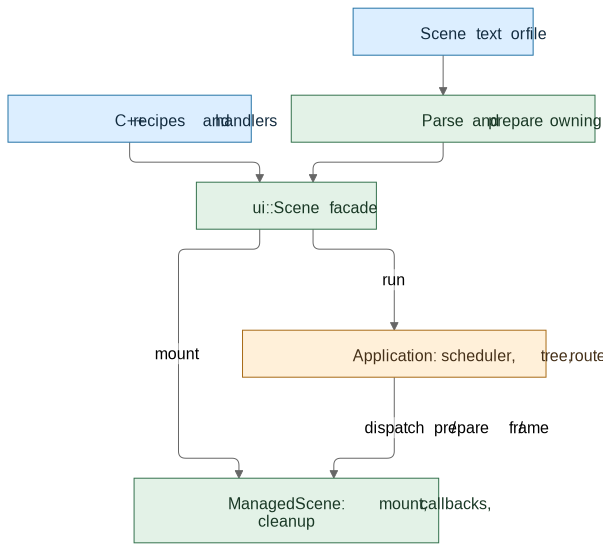
The public ui::Scene facade owns the application and one managed scene. Its prepare and run calls use the existing synchronous lifecycle on one UI runtime; they do not create a second runtime. Scene-resource parsing and preparation are implemented behind the public resource API in the library sources, while the resulting owning recipes join the same scene mount transaction. See ui_scene_pipeline.hpp, ui_scene_resource.hpp, ui_app.cpp, and the scene loading guide.
The diagram summarizes preparation paths and retained services. The runner uses the existing scheduler, tree and router.
Versioned architecture maps
The archived maps below describe the M1 source revision 968651a. The current architecture is described by the other diagrams and sections on this page.
Historical M1 snapshot (revision 968651a)
The offline architecture viewer contains ownership, lifecycle, frame, errors and milestone maps. All data is embedded; it needs no server, CDN or additional installation. Choose English or Russian, a map and a node to inspect its contract and pinned source. Tab and Enter operate the controls. Each map exports an independent SVG. Source links open GitHub and require a connection.
This snapshot describes source revision 968651a90b6a1542fd3ab2cec159b457e548681f. M1 was in progress at that revision. It excludes later changes and does not assert milestone acceptance. The status belongs to this historical snapshot; it does not describe the current project status. The comparison baseline is 849dc6285d7ef863206e8248810ee0650413b0a2. Baseline integration was published as PR #36, whose CI run completed six checks successfully for PR head 28723ed04810c597c2fe31f0d75cd9416c5916ac, then merged as the pinned source revision. Snapshot authoring separately passed eight exporter/source/help tests and 40 offline browser combinations across maps, languages, themes and widths (1440/390 px), including real SVG downloads. These authoring checks do not run the C++ runtime suite. The complete generated documentation and delivered artifact for this new foundation are NOT_VERIFIED at this snapshot's authoring boundary; integration checks remain required. The prose after the maps describes the current checkout and can evolve after this pinned snapshot.
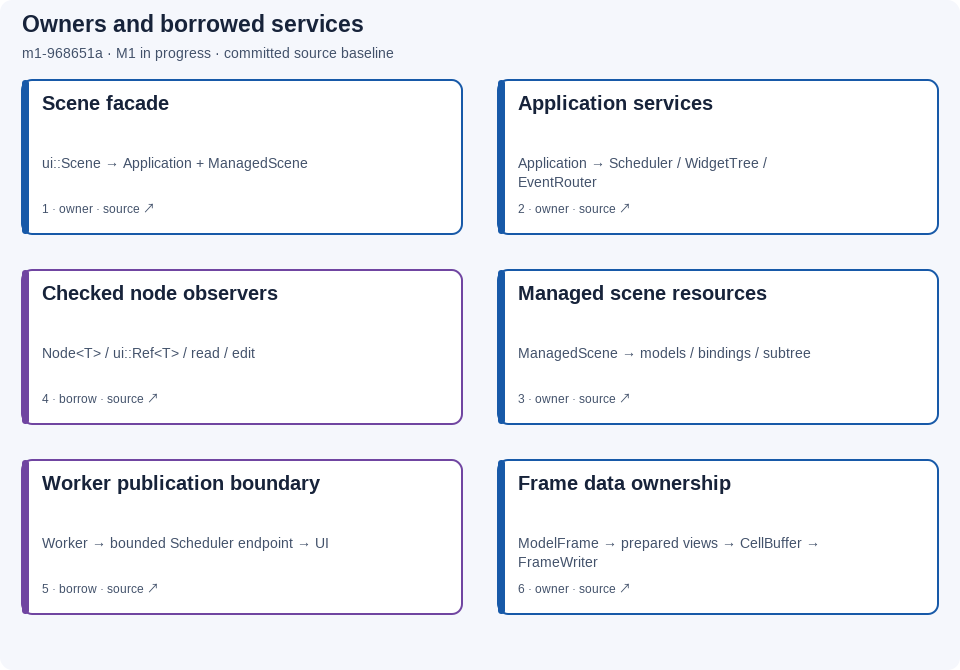
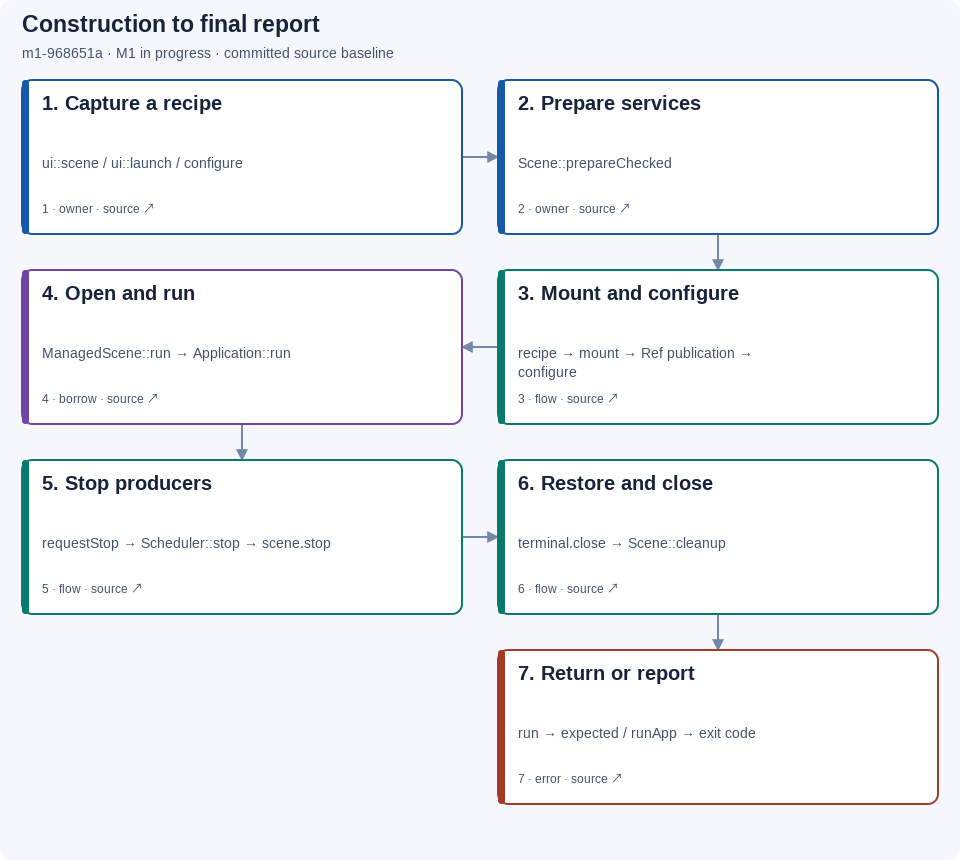
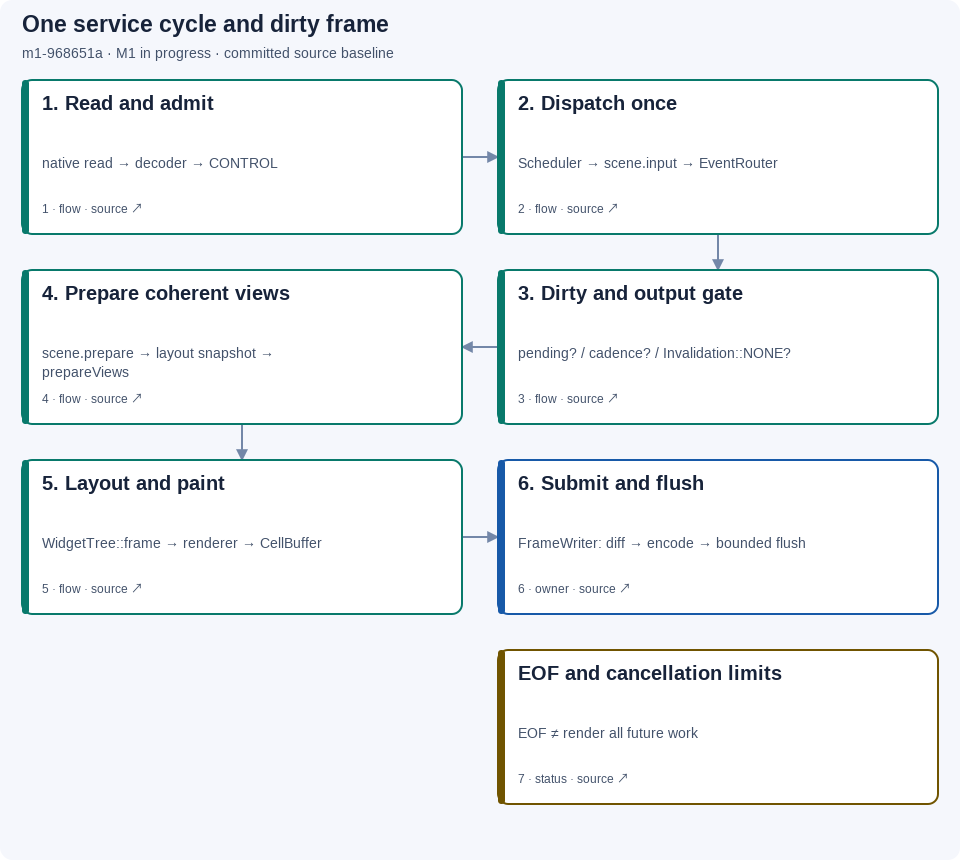
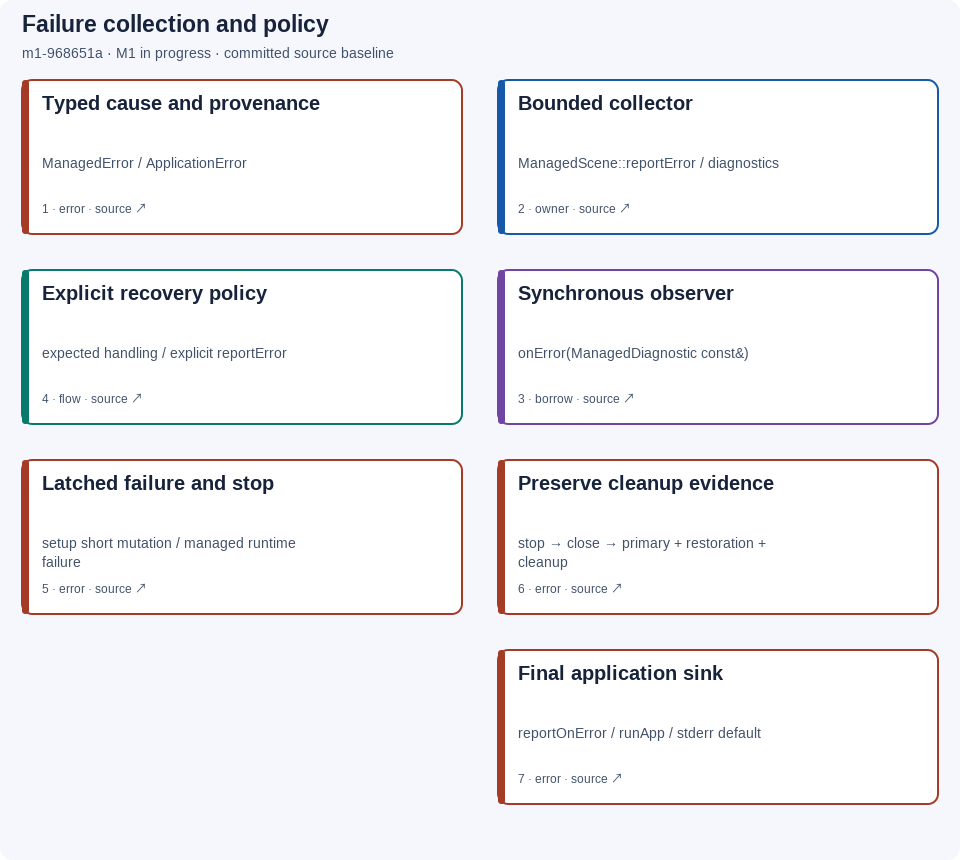
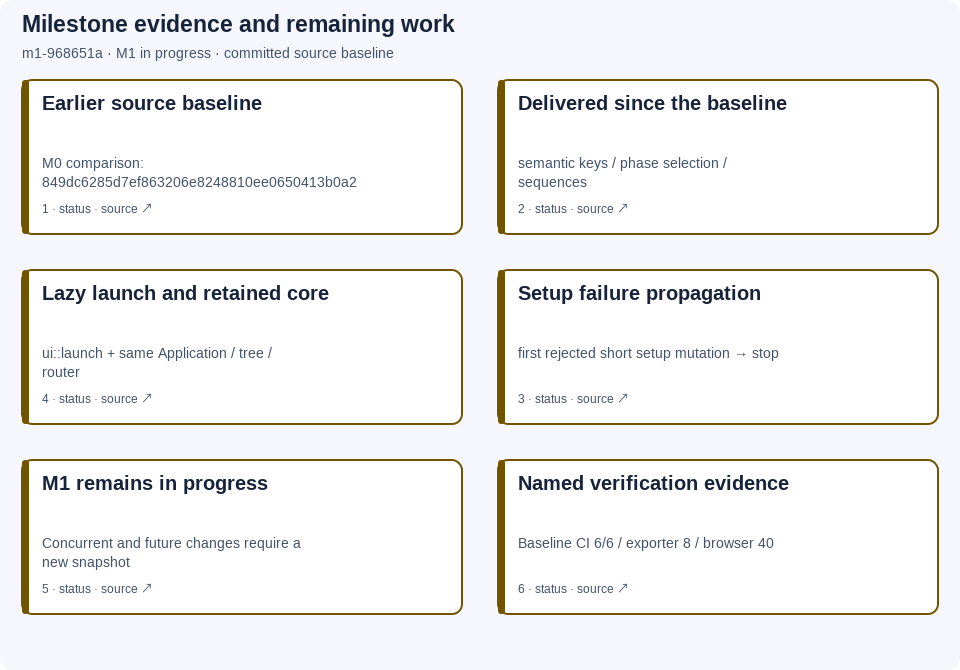
Blue cards describe owners, purple cards observers or borrowed services, green cards work coordination, red cards error boundaries, and ochre cards status and limits. Text also names each role. Lifecycle and frame arrows show the normal successful path; the error map explains failure exits. Other card order is a reading path; ownership relations are explicit in each node's details.
Maintaining snapshots
The readable maps.json generates the checked-in SVG and HTML. SVG exports work without JavaScript in repository Markdown and generated documentation. SDK users need no Python, Node.js or diagram renderer. Authors use the existing Python developer-tool environment and the standard-library-only exporter.
For an integrated milestone, create a new directory named <milestone>-<source-revision-prefix> under docs/architecture/snapshots. Copy the manifest, set a unique id, full revision, comparison revision and accurate bilingual status. Update every node and source reference against that revision; describe new behavior, changed guarantees and retained invariants. Intermediate snapshots use an in-progress status; closure requires the project's verification and review evidence. Future targets have no fabricated revision or generated snapshot.
Generate and check with --source <directory>/maps.json. Verify pinned links, exact regeneration, EN/RU parity, SVG text and connectors, desktop and narrow screens, both themes, keyboard navigation and export. Obtain bounded independent fact review and check the delivered documentation artifact. Add the snapshot to this page and its translation; register its directory in the documentation asset copy step. Keep previous snapshots unchanged; corrections get a new snapshot ID. The publishing commit records the exporter/template version and verification evidence. The manifest revision identifies runtime source and can precede the commit that publishes its documentation.
One event loop, explicit service bounds
Application::run coordinates the loop; Scheduler::dispatch performs one bounded dispatch and starts no thread. Each service cycle admits bounded input, dispatches once, prepares/renders a ready dirty frame at most once, and services pending output at most once. One native batch/raw suffix and one rejected CONTROL owner survive admission pressure. Input is retained rather than silently dropped. Windows supplies decoded events; POSIX bytes retain arrival timestamps for streaming decoder deadlines.
The native terminal read is the wait primitive. Positive inputSlice deadlines also bound when worker publications are serviced; scheduler waitFor is not a universal wait covering native terminal I/O. Pending output prevents another submission, leaving dirty state in the tree. Frame cadence is measured from actual submission/completion; late work causes no catch-up burst. Idle samples input and resize, but emits no periodic frame without invalidation.
CONTROL and DATA have separate capacities and budgets. REPLACE_LATEST can coalesce a complete display snapshot for the same sender. Lossless domain aggregation must happen first: dropping a display snapshot is different from dropping a financial tick. The dashboard aggregates each generated tick into OHLC before publication; its provider runs on the UI thread. Queue bounds limit retained owners, not arbitrary payload bytes or callback duration. See scheduler and Application.
From input and models to output
Action processing and frame construction
- Admission creates a diagnostic input token when tracing is enabled, then publishes an owning CONTROL payload. The queued token survives dispatch.
- scene.input may handle a global command; otherwise EventRouter resolves focus/hit target and action, then invokes the checked handler.
- Property assignment compares immutable values. An equal value creates no new invalidation; a changed value invalidates and queues observers. A successful property receipt can still report notification rejections.
- When a dirty frame can be submitted, scene.prepare synchronizes bindings and takes one pin per model. Sibling table/chart views prepare from that pin at their final extents. Provider request receipts are handled outside painting.
- Inside WidgetTree::frame, Application lays out and paints visible nodes, translating local commands through arranged surfaces and clips. The renderer consumes every borrowed text command into an owning CellBuffer before returning.
- FrameWriter receives that buffer and the actual frame token. Diff/encoding and bounded flush happen outside layout/paint. Partial output stays owned; committed state advances only on complete consistent acceptance.
A paint/preparation/render failure ends the run with its original component cause; Application does not replace failed widgets with an implicit placeholder. The tree alone does not roll back earlier paint submissions. No partially built frame is submitted by the runner on failure.
The causal chain records queue admission/dispatch, target/action, handler and Property evidence, invalidation/frame ID, and actual diff/output outcomes. Coalesced causes can share a frame; the frame token identifies its first recorded cause rather than an unbounded cause list. Handler return proves neither a domain change nor a displayed frame. A real update can produce an empty diff. Transport acceptance proves no physical display. Ring losses and incomplete chains remain explicit. Diagnostics defines these distinctions; export snapshots after terminal restoration.
Ownership and shutdown
Ownership and observing handles
When using Application directly, construct it first and the ApplicationScene/bindings/models afterward; destroy them before Application. With ui::Scene, the facade enforces its internal owner order; release external services borrowing the application through scene.onStop before managed teardown. The runner borrows the scene for one single-use run. Callbacks must not destroy/reenter either owner. Application releases router/tree before scheduler; retained immutable snapshots have their own payload lifetimes.
Node<T> observes session/slot/generation and owns no widget. Checked read/edit lend a reference only during the callback. Removal closes node scopes and invalidates handles immediately; an active borrow defers physical reclamation until its outer boundary. Cancellation prevents new callbacks but does not unwind one already running or join a provider. Widget tree and model explain those guarantees.
Stop closes the scheduler, calls scene.stop to cancel/join scene-owned producers, then closes the terminal. The same cleanup is attempted after errors and pre-requested cancellation. ApplicationError retains the first phase/cause and a separate restoration error. Diagnostics/error printing belongs after run.
EOF finishes decoding, delivers admitted CONTROL and flushes submitted output. It does not wait for future frames/timers/DATA. A delivered edit may stay dirty and never appear in the final frame. Cancellation can stop earlier. A retryable output transaction stays with FrameWriter; any transport error, including Windows OUTPUT_UNCERTAIN, ends the run without reopening or replaying uncertain bytes. Native close depends on host/driver progress and has no hard shutdown deadline.
Managed geometry observation uses that same loop. Ref::geometry() reads an owning snapshot from the last successful final layout and returns a typed error while geometry is invalid; the read does not arrange or render. Scene-owned onLayout observers receive initial and changed snapshots on a later dispatch, outside WidgetTree::frame. Queue pressure retains the latest pending snapshot for bounded recovery through the existing scheduler. At EOF, the runner drains only pending layout observations owned by that scene; it does not wait for unrelated DATA or create a final frame outside the configured frame cadence.
The style-layer benchmark records paired legacy/layered workloads, ordinary allocation counts and requested bytes inside the measured update and frame phases, plus work counters and raw samples. Its quality adapter retains the raw JSON with provenance. These observations exclude aligned allocations, malloc, live/peak memory and work outside those phases, so they describe the stated workload rather than universal runtime cost.
Scene resources use the existing lazy scene recipe and mount transaction. The recipe copies a string source when it is built; it reads an explicitly typed file source during scene preparation. Before any resource node is mounted, the loader parses and validates the full bounded grammar, builtin or explicitly registered type and property schema, duplicate IDs, and resolved text. It then builds recipes that own their widget descriptions and mounts them through the enclosing transaction. Localization uses the supplied TextResolver; PSS remains its own existing style stage. The defaults cap input at 1 MiB, node count at 4096, depth at 64, each decoded string or resolved text at 64 KiB, and properties per node at 16. The hard depth ceiling is 64 because parsing uses the native stack. Typed resource failures retain the source text or file path and byte position, with the file system cause preserved for file errors. See the scene loading guide for syntax and the public calls.
Coherent views and customization
ModelFrame<T> pins one immutable revision. Sibling virtual lists/tables/charts use independent scoped ranges of the same pin, retaining bounded visible presentation plus overscan. Tables read one range for all columns. Stable RowId/ColumnId identities preserve meaning across reorder; an index cannot. Readiness, errors and cancellation remain explicit. Preparation starts no hidden provider worker. See virtual list, virtual table, scroll and chart.
Extend ApplicationScene for global input and model preparation, public widget hooks for custom presentation, typed formatters for columns, and options for resource bounds, width policy and cadence. Retain owning prepared data through rendering; paint must not perform I/O, mutate models or dispatch the scheduler. Typed themes/PSS change presentation within the same tree/frame path.
The runnable examples include owning declarative scenes and custom widgets. The experimental UI coroutine adapter runs bounded timer and receive waits on the existing scheduler. Application-wide Undo/Redo, system clipboard adapters and Drag-and-Drop remain planned work; see planned features for status and milestones.